Event 1
Knocknaree children’s disappearance (1984)
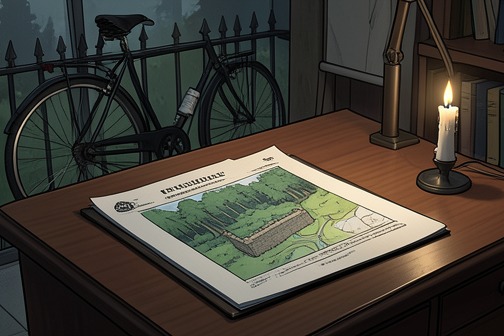
The [Knocknaree children’s disappearance (1984)](entity:event-recall-event-knocknaree-children-s-d-98f6dbb78cf4) is the unexplained vanishing of [Germaine Elinor Rowan](entity:character-recall-character-germaine-elinor-row-b56225de94c0) and [Peter Savage](entity:character-recall-character-peter-savage-a032081bc460) after they entered the wood with [Adam Ryan](entity:character-recall-character-adam-ryan-722038688481) on [14 August 1984](entity:time-recall-time-1984-8-14-de0b3920cd84). Its decisive and enduring fact is that Adam was found, but could remember nothing of what had happened, while the other two children were never recovered. Recounted through a police file read by [Rob Ryan](entity:character-recall-character-rob-ryan-18e1297f6a56) the day after he became a detective, the case is assembled from witness accounts, physical traces, and a silence no search could resolve.
## Background and the children’s last known movements
On the afternoon of Tuesday, 14 August, three twelve-year-olds were playing in the road where their houses stood in [Knocknaree](entity:location-recall-location-knocknaree-d62cd5a36cda), a small town in [County Dublin](entity:location-recall-location-county-dublin-83d4062095e1). It was hot and clear; residents were out in their gardens, and witnesses saw the children balancing along a wall, riding bicycles, and playing on a tire swing. The estate was then sparsely developed, with a sizable wood adjoining it beyond a five-foot wall.
At about 3 p.m., the children left their bicycles in the Savages’ front garden and told [Peter](entity:character-recall-character-peter-22e18a2305ec)’s mother, Angela Savage, that they were going to play in the wood. They often went there and knew that part well, so she did not fear that they would get lost. Peter had a wristwatch, and his mother told him to be home by 6:30 for tea. Her account was confirmed by her neighbor, Mary Therese Corry; other witnesses saw the children climb over the wall and enter the wood. These ordinary, publicly witnessed departures establish the children’s last known destination, but not what followed them inside.
The prospect of running away was considered during the first search. Germaine’s mother, Alicia Rowan, had arranged for her to attend boarding school in [Dublin](entity:location-recall-location-dublin-d76fcbad2c3f) during the week and return to Knocknaree at weekends. Germaine was due to leave two weeks later, and all three children had been upset by the thought of separation. Yet a preliminary examination of their rooms found no missing clothes, money, or personal belongings. Germaine’s Russian-doll piggy bank, containing £5.85, was intact.
## The search and Adam’s discovery
When Peter had not returned by 6:45, his mother checked with the other children’s mothers, assuming he might be at one of their homes. None of the three had returned. Peter was normally reliable, but at first the parents supposed that the children had become absorbed in a game and lost track of time. Shortly before 7 p.m., Angela Savage walked a short way into the wood and called for them. She heard no answer and noticed nothing to indicate that anyone was there.
After tea, Peter’s father, Joseph Savage, and Adam’s father, John Ryan, went farther into the wood and called again, still without response. At 8:25, as darkness began to fall, the parents became seriously concerned that the children might be lost. Alicia Rowan, who had a telephone, called the police. The search began that night and continued for weeks: volunteers combed fields and hills, explored known bog holes and drains, and sent divers into the river running through the wood.
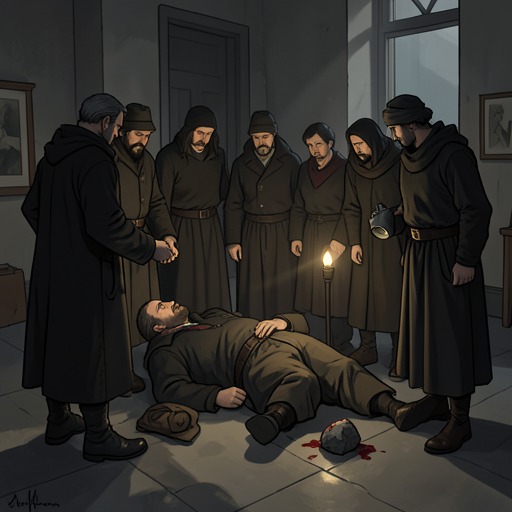
At 10:20 p.m., a policeman using a torch found Adam in dense woodland near its center. He stood with his back and palms pressed against a large oak. His fingernails had dug so deeply into the trunk that they broke off in the bark. He appeared to have been there for some time, yet had not responded to the searchers’ calls. The Dog Unit followed the scents of the two missing children to a point not far from where Adam had been found; there the dogs became confused and lost the trail.
## Physical evidence and interrupted memory
Adam was wearing blue denim shorts, a white T-shirt, white socks, and white lace-up running shoes. The shoes were heavily bloodstained, and the socks less so. Later analysis found that blood had soaked through the shoes from the inside out, while the lesser staining on the socks had passed from the outside in. Investigators inferred that the shoes had been removed, blood spilled into them, and the shoes put back on after the blood began to coagulate, transferring some to the socks. The T-shirt had four diagonal tears across the back, each between three and five inches long.
Adam had minor scratches on his calves, splinters beneath his fingernails consistent with the oak, and a deep abrasion on each kneecap. A five-year-old child, Aideen Watkins, said she had seen him fall from a wall earlier that day, but her account varied when retold and was considered unreliable. The file therefore preserves uncertainty even around injuries that might otherwise seem to offer a straightforward explanation.
The blood on the shoes and socks was type A positive. Adam’s blood was also A positive, but investigators judged that his knee abrasions were unlikely to have produced enough blood to account for the heavy staining inside the shoes. Germaine’s medical records showed that she was also A positive. Peter was excluded as the source because both his parents were type O, making it impossible for him to have another blood type. With no DNA analysis available in [Ireland](entity:location-recall-location-ireland-3247a2c8bcbe) in [1984](entity:time-recall-time-1984-db6e36e8c14e), the tests could not establish whose blood it was: investigators could not exclude either a fourth person or multiple sources.
Adam was physically uninjured apart from the described scratches and abrasions, but his response was profound. He made no voluntary movement for almost thirty-six hours and did not speak for another two weeks. When he did speak, he had no memory of the interval between leaving home that afternoon and being examined in hospital. The sole child recovered from the wood could thus provide no account of the disappearance; his condition became evidence of distress without becoming an explanation.
## The watch, the unanswered search, and the case’s form
Fourteen months after the disappearance, local resident Andrew Raftery found a wristwatch in undergrowth about two hundred feet from the oak where Adam had been discovered. Its face showed a cartoon footballer in action, and a football tipped its second hand. Peter’s parents identified it as his, and his mother confirmed that he had worn it on the day he disappeared. The plastic strap appeared to have been torn forcefully from the metal face, possibly after catching on a low branch as Peter ran. The [Technical Bureau](entity:organization-recall-organization-technical-bureau-456686996d47) found partial fingerprints on the strap and face, all consistent with prints on Peter’s belongings.
The watch gave investigators a specific trace in the wood, but it did not reveal what had happened to Peter or Germaine. Despite police appeals and a prominent media campaign, no further trace of either child was found. The search’s extensive geography—woodland, fields, hills, bogs, drains, and river—stands in contrast to the meagerness of what it yielded: Adam, the blood evidence, and Peter’s separated watch.
The file’s form shapes the reader’s understanding of the event. Rob Ryan presents the case as something read after he became a detective, a record he says he will return to in different ways. Witnesses establish the afternoon’s routine and the children’s entry into the wood; the medical observations and recovered watch narrow some possibilities but leave essential questions open. The narrative offers no confirmed account of violence, no identified source for the blood, and no conclusion about the missing children’s fate. Its unresolved evidence is also personal for Rob: the file concerns the childhood disappearance from which he alone returned, while his own memory of the central interval is absent.
Event 2
Operation Vestal
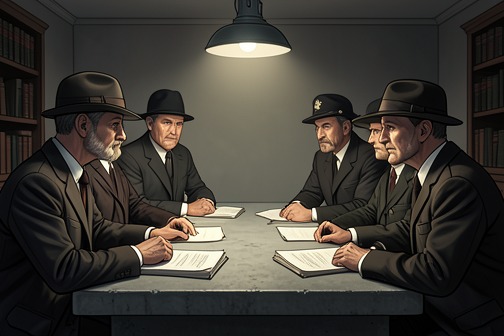
[Operation Vestal](entity:event-recall-event-operation-vestal-c37baedeac53) is the investigation into [Katy Devlin](entity:character-recall-character-katy-devlin-0f044f95eda4)’s death, a case whose apparent lack of direction conceals a pattern of family manipulation and whose investigation briefly reopens [Rob Ryan](entity:character-recall-character-rob-ryan-18e1297f6a56)’s buried connection to [Knocknaree](entity:location-recall-location-knocknaree-d62cd5a36cda). Led by Rob and [Cassie Maddox](entity:character-recall-character-cassie-maddox-309104c455a6), the operation expands rapidly across the estate and its surrounding area. Its early work produces more noise than answers; only later do the small, disconnected details begin to align, even as Rob’s own recovered memories eventually disappear again.
## Launch and investigative scope
The operation begins with a briefing for a large team of detectives and other personnel. O’Kelly announces the headquarters-assigned name, Operation Vestal, whose reference to an ancient sacrificial figure sits uneasily beside the facts of the case. Rob and Cassie recognize the name’s possible ritual associations, while O’Kelly objects that it may encourage people to imagine a cult motive. The exchange establishes a tension that persists through the investigation: the imagery surrounding [Katy](entity:character-recall-character-katy-670ee7b5b514)’s death can invite dramatic explanations, but the team must work from evidence.
Cassie gives the team an account of the case but minimizes the possible connection to the [1984](entity:time-recall-time-1984-db6e36e8c14e) disappearances, presenting it as a remote possibility she can investigate in spare time. The detectives divide up extensive practical work. They plan door-to-door inquiries across the estate, establish a public tip line, seek information on sex offenders near Knocknaree, check with British police and transport authorities for suspicious recent arrivals in [Ireland](entity:location-recall-location-ireland-3247a2c8bcbe), and obtain Katy’s medical and school records alongside full background checks on the Devlin family. Rob, Cassie, and [Sam](entity:character-recall-character-sam-d93f992a0ed0) O’Neill leave the team to carry out those assignments and go to see [Dr. Cooper](entity:character-recall-character-dr-cooper-a0d068e0f3f9).
The circumstances at the Devlin home shape the initial search. Katy had not been taken from her bed: she had put on outdoor clothes after her parents were asleep and left on her own, carrying her house key because she expected to return. The detectives search the bedroom she shared with [Jessica Devlin](entity:character-recall-character-jessica-devlin-ea876c49a0f5), considering both clues to where Katy might have gone and the possibility that a family member could have staged her departure. The room’s contrasting displays—Jessica’s idealized art and Katy’s ballet pictures, including her [Royal Ballet School](entity:location-recall-location-royal-ballet-school-6e4473391811) acceptance letter—offer a concrete view of the sisters’ different interests, but no immediate explanation of Katy’s death.
## An expansive search and a stalled case
During the first two weeks, the team and local officers speak with everyone living within four miles of Knocknaree and with people who had known Katy. They check the Devlins’ Mass cards and trace people who contributed to Katy’s fees; they also monitor who leaves flowers at the altar stone. Investigators interview Katy’s friends, including Christina Murphy, Elisabeth McGinnis, and Marianne Casey. The girls are upset but have no useful information about the death. Their concerns about Jessica’s possible learning disability and their questions about whether a sexual offender was responsible broaden the inquiry without resolving it.
The tip line brings an exceptionally large volume of calls, many irrelevant or founded on prejudice, speculation, or claims of visions. Investigators follow up even when the callers’ theories appear implausible. They also examine convicted sex offenders in south [Dublin](entity:location-recall-location-dublin-d76fcbad2c3f) and people suspected of online predatory behavior but never convicted. Cassie’s initial sense that the crime did not fit a sexual motive does not spare the team from checking these possibilities; it remains one hypothesis among several, not a substitute for investigation.
The work is exhaustive but, in the investigators’ own retrospective account, initially goes nowhere. Leads end in dead ends, public pressure mounts, and O’Kelly urges the team not to give up. Newspapers demand justice and circulate imagined likenesses of [Peter Savage](entity:character-recall-character-peter-savage-a032081bc460) and [Jamie Rowan](entity:character-recall-character-jamie-rowan-1e76ac362340) as adults, drawing the old disappearances into public attention as well as the investigation’s wider atmosphere. Rob remembers this period as a sequence of fragments—faces, phrases, rooms, and calls—that seemed disconnected at the time. Hindsight makes those fragments appear ordered, but that later clarity does not remove the strain and uncertainty of the initial search.
## Medical and family evidence
Katy’s medical records provide one of the investigation’s most consequential leads. She had been healthy apart from ordinary childhood illnesses until she was eight and a half, when severe bouts of stomach illness began. After a particularly bad episode, exploratory surgery led to a diagnosis of idiopathic pseudo-obstructive bowel disease with atypical lack of distension. The diagnosis named the condition but did not explain its cause. Rob raises the possibility that someone might have induced or exaggerated Katy’s illness, but Cassie notes that the available information does not fit a straightforward pattern of a parent seeking attention through medical care: [Margaret Devlin](entity:character-recall-character-margaret-devlin-ba0e5d595195) had no medical background, and other family members, including Jonathan and [Rosalind](entity:character-recall-character-rosalind-239002ff9e41), had sometimes taken Katy to hospital.
The records therefore open a question rather than settle one. In retrospect, that distinction matters: a plausible suspicion is not yet a proven account of what happened. The team’s investigation later uncovers [Katy’s diary](entity:object-recall-object-katy-s-diary-3a274ab47d0c), which records Rosalind pressuring her to take something that Katy believed made her ill and linking it to her ability to dance. Katy also writes of being frightened by Rosalind’s anger and of losing contact with friends after Rosalind attributed hostile remarks to her. The diary gives the medical pattern a personal context and points toward deliberate interference with Katy’s ballet ambitions.
## Interrogation and the limits of confession
The investigation’s interview with [Damien Donnelly](entity:character-recall-character-damien-donnelly-53edf227b71e) produces an admission, but not a complete or reliable explanation. Cassie describes her longstanding view that the killer was someone who did not want to kill and was not naturally violent. The detectives use that theory to encourage Damien to see confession as a way out of continuing fear. After Rob asks whether their description sounds familiar, Damien gives a small nod. In the subsequent account of the killing, he says that Katy arrived earlier than expected, brought chocolate biscuits, and spoke briefly about ballet school before he directed her attention toward a shelf and struck her with a rock.
That admission does not resolve the whole case. Damien’s account omits evidence concerning an archaeological trowel found in a toolshed. Rob confronts him with the post-mortem findings and the newly located tool, indicating that Katy had suffered an additional assault after her death. Damien breaks down rather than offering an explanation that accounts for the evidence. The scene thus distinguishes his admission to killing Katy from a full disclosure of the events and motive: the interview yields important information, but his version remains incomplete.
Damien also describes Rosalind as someone he loved and believed had entrusted him with a secret. He says she had portrayed herself as being mistreated at home and had refused to leave Jessica behind, even when he proposed that they move away together. He presents her refusal as an act of courage and explains that she feared intimacy because of her past. These claims help explain Damien’s emotional investment in Rosalind, but they do not establish that his account of her family life is true. The investigation supplies counterevidence: the records contradict key claims he repeats, and Katy’s diary provides a different account of Rosalind’s treatment of her.
## Revelations and retrospective cost
The later evidence changes the meaning of the early medical clue. In a recorded exchange during the investigation, Rosalind says that she wanted to stop Katy from becoming too self-important and resented the attention she received for ballet. She admits that she had tried to stop Katy dancing by making her sick. Katy’s diary independently records Rosalind insisting that she take something despite Katy’s suspicion that it caused her illness. Together, the confession and diary connect the recurring illness to Rosalind’s efforts to control Katy’s choices and attention.
Operation Vestal also has a consequence for Rob that reaches beyond the solved details of Katy’s death. During the investigation, memories associated with Knocknaree return to him, including people and events from his childhood. Months later, while alone in his apartment, he finds that nearly all of those recovered memories have vanished again. [Peter](entity:character-recall-character-peter-22e18a2305ec), [Jamie](entity:character-recall-character-jamie-9ab1c29c9c6f), the wood, and the other scenes he had struggled to remember now feel distant and secondhand; only one image of himself and Peter remains. The operation therefore brings Rob closer to the history he had lost without restoring it permanently.
As an account of police work, Operation Vestal moves from broad canvassing and competing hypotheses toward the more intimate evidence of medical records, a diary, and interviews. As a narrated event, it is also shaped by belated understanding: Rob acknowledges that the clues only formed a pattern later, and his own connection to the 1984 events is initially held at a distance. The investigation’s early frustration is not simply an interval before the answer. It is the condition under which evidence accumulates, while the cost of that accumulation falls on Katy’s family, the detectives, and Rob’s unstable access to his own past.
Event 3
The disappearance of Peter Savage and Jamie Rowan
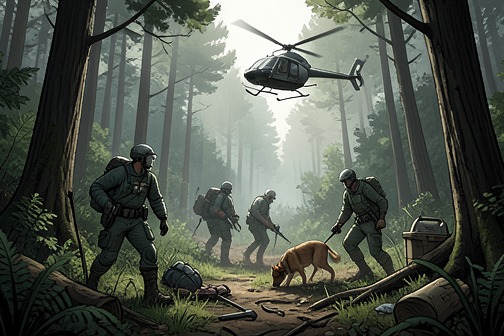
[The disappearance of Peter Savage and Jamie Rowan](entity:event-recall-event-the-disappearance-of-pe-a35418b5c282) is the unresolved [1984](entity:time-recall-time-1984-db6e36e8c14e) case at the center of [Rob Ryan](entity:character-recall-character-rob-ryan-18e1297f6a56)’s buried childhood and later investigation. The two children vanished after spending an afternoon with [Adam Ryan](entity:character-recall-character-adam-ryan-722038688481) in [Knocknaree wood](entity:location-recall-location-knocknaree-wood-26139c5265ab); Adam was found there during the search, but could not remember what had happened. Years afterward, recovered fragments offered new context for the children’s last hours without resolving their fate. The case’s force lies partly in that gap: evidence and memory return, but the answer does not.
## The Disappearance and the Search
In 1984, [Peter Savage](entity:character-recall-character-peter-savage-a032081bc460) and [Jamie Rowan](entity:character-recall-character-jamie-rowan-1e76ac362340) disappeared from the [Knocknaree](entity:location-recall-location-knocknaree-d62cd5a36cda) area. Adam Ryan had been with them that afternoon. Searchers found him in the wood a couple of hours into the operation, shaken but without injuries; there was blood in his shoes, and he could not recall what had happened. The surviving account establishes neither where the missing children went nor whether they left the wood. Their disappearance remained an open case rather than a resolved account of their fate.
The search, as retired investigator [Kiernan](entity:character-recall-character-kiernan-9eb2ed710c0d) later recalled to [Cassie Maddox](entity:character-recall-character-cassie-maddox-309104c455a6), was extensive. Dogs, helicopters, and divers were deployed, while police officers and volunteers searched the surrounding wood, hills, and fields for weeks. Investigators followed leads as far away as Belfast, Kerry, and Birmingham. The scale of the effort did not overcome its central difficulty: despite searching in many directions, they found no answer that explained the children’s disappearance.
Kiernan retained a suspicion that the search had been directed the wrong way and that the answer might have been close at hand. His theory was that the children had never left Knocknaree. He thought a local person might have watched them, approached them in or near the wood, and lured them to a nearby house. In this account, Adam escaped and returned to the wood while [Peter](entity:character-recall-character-peter-22e18a2305ec) and [Jamie](entity:character-recall-character-jamie-9ab1c29c9c6f) did not. Kiernan speculated that the other children might have been killed and their bodies hidden or disposed of, possibly in the wood. These were investigative conjectures, not established findings; the narrative supplies no confirmation of the children’s fate or of Kiernan’s proposed explanation.
## Adam Ryan and the Case’s Afterlife
For Adam, the disappearance did not end when the searchers found him. His inability to remember the day became part of the case and of his identity. As a boy, he knew that Peter and Jamie had disappeared and imagined that they might return. At boarding school, he was intensely homesick and pictured Jamie beside him or Peter in the next bed. He sent imagined messages to them in bottles floated down the school stream, linking their return to the possibility that he could go home. The disappearance thus persisted not only as a police inquiry but as a private expectation that the lost children might still reappear.
As an adult, Adam kept his connection to the case secret from almost everyone. His parents and Cassie Maddox knew, as did a few people from his earlier life, but he did not tell colleagues generally. At boarding school he had dropped the name Adam and adopted his middle name, in part because publicity about the disappearance had made him recognizable. When a later investigation seemed capable of connecting with the old case, he knew he should inform [O'Kelly](entity:character-recall-character-o-kelly-434097b87446). He chose not to: disclosure would likely have removed him from the case under the rule against investigating matters involving personal emotional conflict, and might have subjected him again to questioning about the day in the wood. He also admits that the idea of carrying an unsuspected secret appealed to his ego and to his sense of himself as an enigmatic detective. His silence therefore both protected him from renewed scrutiny and compromised his position on the investigation.
## Recovered Memories and New Questions
The old evidence made the case newly immediate. In a police basement, Adam examined items kept from his childhood: clothes he recognized as his but did not remember wearing, blood-marked running shoes, and Peter Savage’s Donkey Kong game. The game briefly brought back an image of Adam and Peter playing while Jamie watched and called instructions. The other objects did not unlock a continuous memory. Instead, the smallness of the clothes and the Mickey Mouse drawn on a shoe underscored how distant his childhood felt from him.
The clothes also raised unanswered questions. Adam had read about the parallel rips across the back of his T-shirt but had never seen them before. He could not explain how they had been made. When he realized that the shoes might be sent for new forensic testing, he understood that the old disappearance could return to active investigation. A DNA result might prompt comparison with blood evidence from the altar stone and lead investigators to seek samples from Peter Savage’s parents, Jamie Rowan’s mother, and Adam himself. This was a possibility he feared, not a result the account reports. The evidence offered a route to renewed inquiry, not proof of what had happened to Peter and Jamie.
Under the pressure of the investigation, Adam began deliberately trying to remember. He walked for hours, sometimes in the early morning, and found that images surfaced in fragments rather than as a reliable, complete account. One recovered memory placed Adam, Peter, and Jamie near a clearing where they witnessed a violent attack on [Sandra Scully](entity:character-recall-character-sandra-scully-185d04c9c6be). The recollection establishes that the children saw something dangerous; it does not establish that the attack caused their disappearance or explain what happened afterward. The difference matters: a vivid fragment can change the questions raised by the case without supplying a verified solution.
## An Unresolved Ending
Adam’s recovered memories did not remain securely available to him. After [Operation Vestal](entity:event-recall-event-operation-vestal-c37baedeac53), during months spent alone in his apartment, he turned his thoughts back to Knocknaree and found that the scenes he had worked to retrieve were gone. He could remember having remembered Peter, Jamie, and the events in the wood, but those images now felt remote, like scenes from an old film or stories heard from someone else. He feared that even these distant impressions would eventually disappear. Only one image of Peter remained: the two boys trying, unsuccessfully, to make a periscope from rolled newspaper because they had no cardboard tube.
The disappearance therefore ends without a disclosed resolution. The police search, Kiernan’s theory, the recovered evidence, and Adam’s unstable memories each bring the case into sharper view, but none confirms where Peter Savage and Jamie Rowan went or what happened to them. Its narrative structure echoes that uncertainty: the reader receives pieces of the past through Adam’s delayed and repeatedly lost recollections, while the children’s absence remains the fact those pieces cannot repair.
Event 4
Peter and Jamie’s disappearance in Knocknaree Wood
[Peter and Jamie’s disappearance in Knocknaree Wood](entity:event-recall-event-peter-and-jamie-s-disap-9d0613d3badb) remains unresolved in [Rob Ryan](entity:character-recall-character-rob-ryan-18e1297f6a56)’s account: the children were never found, and Rob, who had also been in the wood, returned without a clear memory of what happened. The event shapes his later investigation not through a recovered explanation of the disappearance, but through the conflict between his private connection to it and the fragments of childhood memory that surface and recede.
## The Disappearance and Its Aftermath
The disappearance took place about twenty years before Rob and [Cassie Maddox](entity:character-recall-character-cassie-maddox-309104c455a6) asked Mrs. Fitzgerald about the children. She remembered that [Peter](entity:character-recall-character-peter-22e18a2305ec) and [Jamie](entity:character-recall-character-jamie-9ab1c29c9c6f) had vanished in the wood and that neither had been found; in her account, there had been no proper funeral. The absence of bodies or a known resolution left the event open in the community’s memory.
Rob’s own survival made the event a concealed part of his identity. His mother remembered him as a kind, affectionate child and had rejected the assumption that the children had simply run away: she believed Rob would not have left his family that way. His safe return did not bring relief without consequence. His mother later explained that the family moved partly because she could not face the families still suffering over the missing children, and felt guilty that her son had come home safe when theirs had not.
## Rob’s Connection to the Wood
As an adult, Rob knew he should tell O’Kelly that the case he was working on might connect to his own childhood. He chose not to. Disclosure would likely have removed him from the investigation under the rule against working cases involving personal emotional conflicts, and could have brought renewed questioning about the day in the wood. He had experienced earlier questioning as distressing and fruitless: he had no memories to offer, and the detectives eventually stopped returning. Rob believed reopening that process would help neither the case nor the community. He also acknowledged that keeping the secret appealed to his sense of himself as an enigmatic investigator.
When Rob and Cassie returned to [Knocknaree](entity:location-recall-location-knocknaree-d62cd5a36cda), he hesitated at the last moment to visit Peter’s house. The familiar estate did not unlock the past; its roads seemed ordinary, and that lack of recognition left him feeling at a disadvantage. He feared, in some obscure way, that Peter’s family might recognize him before he could recognize them. Instead, he walked to his former home. The address came back by rote, and seeing the house and bedroom window brought a sudden recognition that he had lived there, played in its garden, and left with Peter and Jamie for the wood.
## Recovered Memories and Their Limits
During the investigation, Rob began deliberately trying to remember. Long, sleepless walks through the city became part of that effort, and images from childhood surfaced in fragments: family outings, school details, and moments with Peter and Jamie. The recollections felt powerful to him, but they did not initially explain the disappearance.
A later memory returned abruptly during the night. Rob recalled that he, Peter, and Jamie had approached a clearing and found several men assaulting [Sandra Scully](entity:character-recall-character-sandra-scully-185d04c9c6be). This recovered scene established that the three children had witnessed a serious event in the wood, but it did not supply a complete account of what then happened to Peter and Jamie. Rob’s memory remained discontinuous: he could recall the children moving through the wood together, yet the sequence ended in uncertainty and fear rather than a clear explanation.
## Secrecy, Loss, and the Ending
Rob’s account of the event is shaped by the difference between what the community knew and what he withheld. People remembered two children who had disappeared; Rob knew that he had been there too, but kept that connection from his colleagues while working on a potentially related case. His private memories were therefore both evidence of his past and a professional liability he chose not to disclose.
After the investigation, during months spent largely alone in his apartment, Rob’s recovered memories of Knocknaree disappeared again. Peter, Jamie, the wood, and the scenes he had struggled to retrieve became remote, like images from films or stories rather than experiences that belonged to him. Only a single memory of sitting with Peter in the garden remained. The disappearance thus ends, for Rob, not with recovered certainty but with another loss: the children’s fate remains unknown, and his fragile access to the past does not endure.
Event 5
Katy Devlin’s murder
[Katy Devlin’s murder](entity:event-recall-event-katy-devlin-s-murder-720ac140d640) is the decisive event around which the investigation gathers: her apparent choice to leave home initially suggests a planned return, while later evidence exposes coercion and concealed harm within her family. As the detectives test leads and read [Katy’s diary](entity:object-recall-object-katy-s-diary-3a274ab47d0c), the case becomes not only a search for whoever killed her but also an inquiry into what had been happening before her death.
## [Katy](entity:character-recall-character-katy-670ee7b5b514)’s Departure and the Family Home
Katy had not been taken from her bed by an intruder. Her parents were asleep when she switched off her light, got up, dressed in outdoor clothes, and left with her house key in her pocket. The key suggested that she expected to come back, making the departure appear purposeful without explaining where she had gone or what followed.
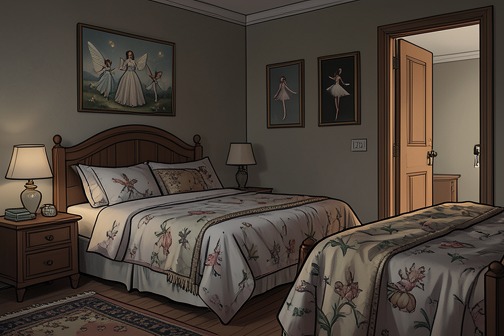
The detectives searched her shared bedroom, including the possibility that a family member might have killed her and staged an apparent departure. Its details set Katy’s ambitions against the room she shared with Jessica: Jessica’s side was decorated with cheerful pictures and fairy imagery, while Katy’s displayed ballet photographs and her acceptance letter from the [Royal Ballet School](entity:location-recall-location-royal-ballet-school-6e4473391811). Her parents said she carefully coordinated her clothes and had learned to do so from a ballet teacher she worshipped. The room preserved a visible account of what mattered to Katy, but could not explain why she had left that night.
## Leads and the Limits of Inference
A computer inquiry produced a result that frustrated [Rob Ryan](entity:character-recall-character-rob-ryan-18e1297f6a56)’s expectations. Investigators confirmed that a suspect connected with the Tracksuit Shadow line had been online while Katy was dying. Although the computer was shared by the suspect’s parents and wife, investigators compared the household members’ distinctive spelling and punctuation habits; the relevant posts matched the suspect’s pattern. Ryan nevertheless reacted as if a promising lead had gone wrong. The finding sharpened the inquiry without, in that moment, giving him the resolution he wanted.
[Cassie Maddox](entity:character-recall-character-cassie-maddox-309104c455a6) also questioned the apparent sexual motive behind the assault associated with Katy’s case. She observed that it seemed to have a token quality rather than a sexual purpose, and raised the possibility that someone with a non-sexual motive might have wanted Devlin’s daughter assaulted using an implement. This redirected attention toward motive and means, but remained an investigative possibility rather than a confirmed explanation.
## Evidence of Control and Illness
The family’s account began to trouble Ryan before he had a clear explanation for why. After [Rosalind](entity:character-recall-character-rosalind-239002ff9e41) said that she had asked questions and been told to be quiet, he gently asked whether everything was all right at home. Her small, uncertain reassurance did not establish what was happening, but it marks a point at which the investigation’s attention shifted beyond Katy’s departure and toward the household around her.
Katy’s diary supplied a more concrete record of distress. She wrote that Rosalind pressured her to drink something by tying it to her future in dancing, and that she was frightened by Rosalind’s anger but had begun to suspect the drink was making her sick. She also recorded being separated from Jessica and the loss of friendships after Rosalind told other girls that Katy had disparaged them. In a later entry, Katy described finding the diary hidden in Rosalind’s wardrobe and taking it to Simone’s home so she could continue writing there. Together, the entries trace pressure, mistrust, and attempts to keep a private record; they do not, by themselves, explain the circumstances of Katy’s death.
During Cassie’s undercover conversation with Rosalind, Rosalind admitted that she had made Katy sick and described doing so as a way to stop her dancing and curb what she saw as Katy’s attention-seeking. The admission gives the diary’s account of illness a disturbing context: what Katy had feared was not simply a health problem but an action imposed by her sister. It establishes Rosalind’s prolonged interference with Katy’s wellbeing, while leaving the murder itself a separate question of responsibility and evidence.
## The Case and Rob Ryan’s Unsteady Memory
As the investigation continued, its pressure reached beyond the immediate evidence. Ryan found himself unable to dismiss the sense that a photograph of Philomena Kavanagh reminded him of something, though he could not identify what. Because he had lost a substantial part of his childhood memory, an ordinary association might be trivial or might point toward something his mind had kept inaccessible. The image therefore became a private source of alarm, not a solved clue to [Katy’s murder](entity:event-recall-event-katy-s-murder-268f0534d2f7).
The case’s significance lies partly in this collision between visible records and uncertain recollection. Katy’s diary preserves her own account of being made ill and socially isolated; the computer inquiry attributes posts through distinctive writing habits; Ryan, by contrast, cannot tell whether his own returning impressions matter. The investigation advances through evidence that can be examined, but its emotional stakes are sharpened by what remains difficult to prove or remember.
Event 6
Sandra Scully’s rape in Knocknaree Wood
[Sandra Scully’s rape in Knocknaree Wood](entity:event-recall-event-sandra-scully-s-rape-in-5afa2a1c8da0) is both an assault witnessed by children and a buried event that returns years later through [Rob Ryan](entity:character-recall-character-rob-ryan-18e1297f6a56)’s damaged memory. Sandra’s account identifies [Shane](entity:character-recall-character-shane-05621ac800e8) as the rapist and [Cathal Mills](entity:character-recall-character-cathal-mills-d951bf7aa723) and [Jonathan Devlin](entity:character-recall-character-jonathan-devlin-79c023bbdeb3) as the men who held her; Rob, [Peter Savage](entity:character-recall-character-peter-savage-a032081bc460), and [Jamie Rowan](entity:character-recall-character-jamie-rowan-1e76ac362340) were nearby and saw what was happening. Its late disclosure ties the investigation to Rob’s own childhood and makes the act of remembering part of the event’s lasting consequence.
## Background and Participants
Sandra was sixteen and dating Cathal Mills, who was nineteen. Jonathan Devlin was Cathal’s close friend and was attracted to Sandra. According to the account [Cassie Maddox](entity:character-recall-character-cassie-maddox-309104c455a6) later gave Rob, Cathal told Sandra that Jonathan wanted to have sex with her and treated the suggestion as if she ought to agree. Sandra was confused by the proposal and ultimately tried to put the episode behind her.
Shane, another friend from the same longstanding group, later wanted to be involved. Sandra disliked him and did not agree. Her account, as relayed by Cassie, was that Cathal and Jonathan held her while Shane raped her. The distinction between the men’s roles matters: the assault was committed by Shane, while the other two participated by restraining her. Their friendship and Cathal’s apparent acceptance of Shane’s demand did not protect Sandra; instead, the group’s loyalties enabled the attack.
The exact date was not established. Sandra remembered bruises on her wrists and worrying whether they would have faded before school resumed, which placed the attack in August [1984](entity:time-recall-time-1984-db6e36e8c14e). A male participant later described the episode as occurring late one afternoon, after the group had spent the day in the clearing drinking alcohol and using drugs. He admitted helping to hold Sandra and said Shane alone raped her. His account adds his own altered perception of the episode, but that description does not change his acknowledged participation or lessen the responsibility established by the account.
## The Assault and Its Immediate Aftermath
Rob’s recovered memory brings the children toward the clearing after they notice sounds that seem wrong. [Peter](entity:character-recall-character-peter-22e18a2305ec), [Jamie](entity:character-recall-character-jamie-9ab1c29c9c6f), and Rob move through the undergrowth and see too many people there: Cathal and Jonathan are holding Sandra, while Shane is assaulting her. The children run away when the men notice them. Rob’s memory fixes the event not as something he understood or intervened in, but as a scene he witnessed and fled.
The next day, Rob and Jamie see Sandra near a shop. She is wearing a large sweatshirt and appears tired. They know she has seen them, but neither side looks directly at the other. The encounter offers no explanation or conversation; the children’s knowledge and Sandra’s recognition remain unspoken. That silence becomes part of the event’s aftermath, as consequential to Rob’s recollection as the brief act of witnessing it.
Years later, Cassie tells Rob what Sandra disclosed during an interview. Sandra had described the assault in minimizing terms, despite the account of being held and raped. Cassie is furious and shaken by this framing, and Rob asks her to recount the story from the beginning. As Sandra’s experience emerges, the investigation’s present-day case begins to overlap with the childhood event Rob has not yet consciously recovered.
## Delayed Recognition and Recovered Memory
Rob’s memory does not return as a deliberate, complete recollection. During the investigation, he has begun cautiously trying to remember what happened in the wood, while knowing that his first twelve years have largely been inaccessible. When he eventually recalls the assault, it comes during a restless night and abruptly wakes him. The scene’s return is therefore belated: the event has been present in his past, but its meaning becomes available to him only as the current investigation unsettles the old blankness.
That recovery changes the significance of what Rob already knows. His childhood self had seen the assault without understanding its place in the wider history of the wood; the adult investigator now connects the remembered scene to Sandra’s account and to people involved in the case. Rob had kept his connection to the 1984 disappearances secret, in part because disclosure could remove him from a case in which he might be emotionally involved. The returning memory makes that concealed personal stake harder to separate from his professional role.
The memory’s later fate remains uncertain and painful. After months of isolation, Rob finds that the recovered scenes from before boarding school, including the people and places associated with the wood, have disappeared from his mind again. He can remember having remembered them, but they feel distant and no longer fully his. The assault is thus narrated through a sequence of absence, sudden return, and renewed loss rather than as a stable recollection.
## Narrative and Thematic Significance
The event reaches the reader through different layers of testimony and memory. Sandra’s account is reported to Rob by Cassie; a participant’s later statement supplies another perspective; and Rob’s own recollection returns as a childhood scene. These strands establish the participants’ actions while also showing how long it takes for the event to be spoken about and connected to its witness. Rob’s memory is vivid when it surfaces, but its recurrence and eventual disappearance prevent vividness from serving as a guarantee of lasting access.
The assault also exposes the distance between what happened and how those involved could describe it. Sandra’s minimization sits beside her account of being forced, while a participant recalls his own impaired perception without denying that he helped restrain her. The narrative gives neither the men’s camaraderie nor their intoxication the force of an excuse. Instead, the event’s consequences lie partly in the silence after the children flee and in the delayed recognition by Rob, whose recovered past turns a childhood witness into an investigator confronting his own connection to the case.
Event 7
The unexplained laughter in Knocknaree Wood
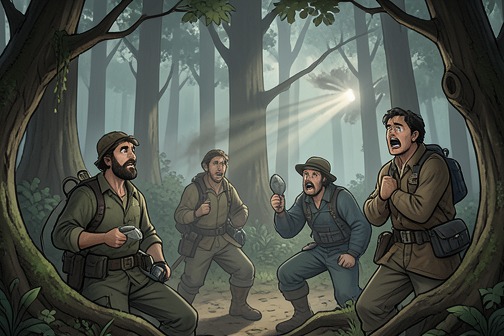
[The unexplained laughter in Knocknaree Wood](entity:event-recall-event-the-unexplained-laughte-a3c5a372c78a) is an unresolved encounter with a voice heard after [Sandra Scully](entity:character-recall-character-sandra-scully-185d04c9c6be) is raped there. Recalled years later through both Sandra’s account and [Jonathan Devlin](entity:character-recall-character-jonathan-devlin-79c023bbdeb3)’s uncertain memory, the sound turns a moment of assault and shock into a second mystery: a presence in the trees that none of the adults can identify, but that may have witnessed more than they knew.
## The sound after the assault
In Sandra’s account, the event follows the rape by [Cathal Mills](entity:character-recall-character-cathal-mills-d951bf7aa723). When it is over, Cathal calls her his girl and kisses her while she is shaking, trying to straighten her clothes, and struggling to compose herself. The sound comes from only a few yards away in the trees. Sandra describes it first by comparison to an enormous bird flapping its wings, then stresses that she is sure it was a voiced call. The distinction matters: what initially sounds like an animal noise is already difficult to classify.
Cathal throws a stone toward the shadows and blames children who have been playing in the wood. The sound continues. Sandra and the others cannot see its source; they jump, yell, and then sit screaming, too frightened to approach. It seems to move away into the wood and sounds, to Sandra, at least as large as a person. She also reports a strong animal smell, like goats or the smell of a zoo. Neither the sound nor the smell supplies a clear explanation; together they make the unseen presence feel physical without making it identifiable.
## Two accounts, one uncertain memory
Sandra’s account reaches [Rob Ryan](entity:character-recall-character-rob-ryan-18e1297f6a56) through [Cassie Maddox](entity:character-recall-character-cassie-maddox-309104c455a6), who raises the possibility that a wild animal might have been in the wood. Rob is taken aback and asks whether the people in the clearing could have been making the noises themselves. His memory offers no confirmation: he recalls running hard, hearing his own rasping breath, and meeting the other children at the edge of the wood, all of them panting and aware that something was terribly wrong. He doubts they would have returned to the clearing to make flapping sounds or produce an animal smell, but cannot use his recollection to settle what happened.
When Rob asks Jonathan about the sound, Jonathan initially says that the wood was full of birds and foxes and that, in the state he was in, he would not have noticed one more or less. His recollection of the aftermath conveys how little confidence he can place in his perceptions. He describes himself shaking and unable to see straight, Sandra gasping as if she could not breathe, and [Shane](entity:character-recall-character-shane-05621ac800e8) lying on the grass, staring up at the trees and twitching. Cathal, meanwhile, begins laughing and staggers around the clearing. Jonathan tells him to stop, and for a moment the two men grapple: Jonathan grabs Cathal, who catches him by the T-shirt.
Then Jonathan remembers that someone was still laughing. He insists that the sound did not come from one of them: it was away in the trees, growing louder into what he remembers as a huge voice. Sandra and Shane scream, and Jonathan admits he may have screamed too. The recollection is not a neat correction of Sandra’s report. It is a second, disturbed account, emerging only after Jonathan has first said he remembers nothing and then paused to retrieve something he had forgotten.
## The unseen witness
Jonathan recalls Cathal shouting about children, but says that the voice did not sound like a child. Children from the estate, perhaps ten or twelve years old, sometimes played in the wood, spied on the adults, and threw things before running away. The sound Jonathan remembers, however, seemed more like a young man’s voice. No one went to investigate. The witnesses were in shock, the laughter became too much for them, and Jonathan remembers being frozen in place. When it stopped and seemed to move into the wood, they left as quickly as they could.
That possibility unsettles Rob for a reason beyond the sound itself. He recognizes that someone in the wood might have seen the rape and might also have seen the children. He nearly asks Jonathan whether the adults were afraid those children would tell someone, and what they might have done to prevent it, but holds back to preserve the interrogation and build a stronger case. Jonathan says he does not know who the laugher was. He recalls that Cathal later wanted to find out who had been there and how much that person had seen. The encounter thus opens a line of inquiry about a potential witness without identifying one.
## Aftermath and narrative uncertainty
Jonathan says the group left the clearing; Cathal struck Shane across the back of the head when Shane continued screaming. Jonathan went home, took some of his father’s alcohol, and got drunk. He cannot say what the others did. These concrete actions establish the terror’s immediate aftermath, but do not establish whether the voice was human, animal, or a product of frightened perception.
The event remains suspended between explanations. Sandra’s animal comparison, the reported smell, and the sound’s movement through the trees support the possibility of an animal; Jonathan’s memory of a voice like a young man’s supports the possibility of another person. His and Sandra’s shock leaves room for imagination to have shaped what they heard, while Rob’s fragmented recollection cannot verify either account. The laughter’s importance lies partly in that unresolved status: it turns an assault witnessed by its participants into a scene with a possible unseen observer, whose presence might connect the adults’ violence to the children in the wood.
Event 8
The Knocknaree land-acquisition and rezoning scheme
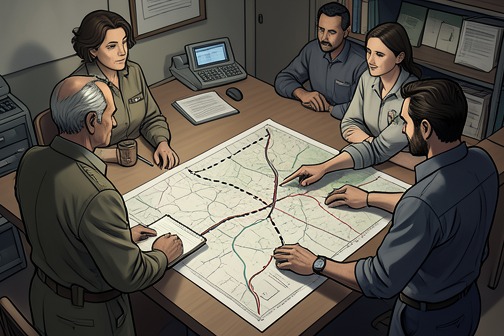
[The Knocknaree land-acquisition and rezoning scheme](entity:event-recall-event-the-knocknaree-land-acq-898cf27cb682) was a sustained effort to acquire farmland around a proposed motorway and secure more valuable development classifications for it. Reconstructed by [Sam O'Neill](entity:character-recall-character-sam-o-neill-050c4eebaac4) from a color-coded map and property records, the sequence made the motorway’s route more than a matter of public infrastructure: it was also a potential source of substantial private gains, and a possible motive for pressure surrounding the route. The evidence suggested coordinated advantage and political influence, but did not establish who, if anyone, had improperly tipped off the buyers or influenced council decisions.
## Route and Early Acquisitions
The map [Sam](entity:character-recall-character-sam-d93f992a0ed0) presented to [Rob Ryan and Cassie Maddox](entity:relation-recall-relation-rob-ryan-and-cassie-7c8c858558f0) marked the planned motorway with parallel dashed lines cutting through [Knocknaree wood](entity:location-recall-location-knocknaree-wood-26139c5265ab) and the archaeological dig. The government announced the route in March 2000, then bought land from local farmers over the following year under a compulsory purchase order. Sam distinguished those public acquisitions from the purchases that made the surrounding land important to his inquiry: farmland beside the route had begun changing hands in late 1995, before the announcement.
Over roughly the next four years, parcels around the future motorway were acquired bit by bit and rezoned from agricultural use to industrial and residential use. The timing prompted the question of whether the buyers had known the eventual route in advance. Sam offered a less conclusive possibility: discussion of a motorway into [Dublin](entity:location-recall-location-dublin-d76fcbad2c3f) from the southwest had appeared in newspapers from about 1994, as [Ireland](entity:location-recall-location-ireland-3247a2c8bcbe)’s economic boom began, and surveyors told him this corridor was an obvious route given the topography and settlement patterns. Developers could therefore have hired surveyors and anticipated the route without receiving a confidential government tip. Sam acknowledged that a tip-off remained possible, but said the evidence did not prove one.
## Companies and Rezoning
By March 2000, three companies were connected to almost all the land around the relevant section of the route. The map distinguished their holdings by color: blue for [Global Irish Industries](entity:organization-recall-organization-global-irish-ind-b9b4afbb6ffc), green for [Futura Property Consultants](entity:organization-recall-organization-futura-property-650503448e53), and red for [Dynamo Development](entity:organization-recall-organization-dynamo-developme-d6edcdd9b43a). Sam’s work had been complicated by layered ownership: many of the named companies were holding companies owned in turn by other companies. He traced the purchases back to those three firms, although he had not established who stood behind them. Two were registered in the Czech Republic and Futura in Hungary.
The records showed that acquisition and rezoning proceeded together. Once the three companies had obtained the land, they applied to have it rezoned and succeeded. Sam’s account placed that outcome against the repeated refusals of the farmers who had retained smaller parcels. The contrast was suggestive of unequal access to decision-making, but it was not, by itself, proof of a corrupt agreement. Sam thought the companies’ opaque structure might point to tax evasion and considered referral to the Revenue; at that stage, he did not see a proven connection to the criminal case.
## The Holdout Farmers
Four farmers held out while the surrounding acreage was being bought. They were friends, had moved to Louth by the time Sam tracked them down, and understood that the offers they received were above the going price for agricultural land. They chose to wait and see what would happen rather than sell immediately. When the motorway plans were announced, they recognized why the buyers had been so interested: the new route would make [Knocknaree](entity:location-recall-location-knocknaree-d62cd5a36cda) more accessible to industrial estates and residential developments. They then tried to obtain rezoning themselves, which could have doubled or tripled the land’s value, but the county council rejected their applications.
The map’s annotations preserved the detail of one farmer’s unsuccessful efforts. Maurice Cleary applied four times—May and November 2000, then June 2001 and January 2002—and each application was refused. His parcel was marked as sold to Futura Property Consultants in August 2002; the land was rezoned two months later. Cleary had wanted to remain on his farm, partly out of determination not to be forced away. According to Sam, a representative of a holding company told him that a pharmaceutical plant would be built beside the farm and that chemical waste might seep into the water and poison his cattle. Cleary understood this as a threat. Sam could not say whether the danger had been real, but reported that Cleary sold; the difference between the treatment of the farmers’ applications and the companies’ successful applications sharpened the suspicion of favoritism.
## Stakes and Limits of the Case
Sam had spoken to county councilors about the rezoning decisions. Their answers, as he recounted them, circled around a formal assurance that decisions had served the community’s best interests and had not been affected by favoritism. The assurance did not resolve his questions. He inferred that influencing decisions across so many cases and so much time would have cost the companies a substantial sum, but this remained an inference, not a demonstrated payment or a proven account of who was involved.
The route itself gave that inference a measurable economic context. Surveyors identified a logical alternative roughly two miles from the planned route, and four or five miles away in some places; the [Move the Motorway campaign](entity:organization-recall-organization-move-the-motorwa-3ab772ace9b1) supported that alternative. Land north of it would remain accessible, Sam believed, but the companies also held substantial land to the south, whose value could fall if the motorway moved. Estate agents told him that industrial land directly beside the motorway could be worth as much as twice the value of comparable land three miles away. Although he had not calculated the total, Sam thought the difference could amount to millions. That potential loss gave the route a clear financial stake, while the map’s careful trail of colored parcels and rezoning dates left the central allegation—whether private interests had shaped public decisions—unsettled.
Event 9
Adam Ryan’s recovered memory of the assault
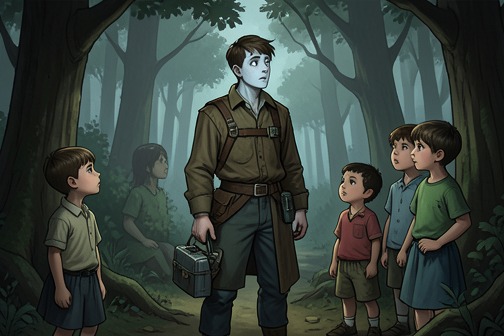
[Adam Ryan’s recovered memory of the assault](entity:event-recall-event-adam-ryan-s-recovered-m-a1b3fff6cfa5) turns an obscure gap in his childhood into a consequential act of witnessing. During the investigation, he recalls that he, [Peter](entity:character-recall-character-peter-22e18a2305ec), and [Jamie](entity:character-recall-character-jamie-9ab1c29c9c6f) saw [Jonathan Devlin](entity:character-recall-character-jonathan-devlin-79c023bbdeb3) and his friends assault [Sandra Scully](entity:character-recall-character-sandra-scully-185d04c9c6be) in [Knocknaree](entity:location-recall-location-knocknaree-d62cd5a36cda) Wood. The memory identifies a crime, places the children at its scene, and makes Adam’s concealed connection to the case impossible to separate from his work on it.
## The Memory and Its Return
For years, Adam had treated his childhood in Knocknaree as largely inaccessible. He rarely discussed the childhood incident that had left his memories missing, partly because he dreaded intrusive questions and speculation, and partly because he regarded the absence as settled. After the original questioning, investigators returned repeatedly, at first during school holidays and later at longer intervals. Adam had nothing to tell them. Their visits eventually stopped, and he believed that reopening the matter would serve no useful purpose.
That silence became an ethical problem when he worked on a case that might connect with his past. He knew he should tell [O'Kelly](entity:character-recall-character-o-kelly-434097b87446) that he could be emotionally involved, but concealed the connection instead. Disclosure, he reasoned, would remove him from the case and expose him to renewed questioning without helping the investigation. He also recognized a less defensible attraction in keeping the secret: it made him feel like an enigmatic detective operating outside ordinary rules. The recovered memory therefore does not arrive in a neutral setting. It surfaces while Adam is already withholding information that could affect his participation in the case.
His return to the past began tentatively. On sleepless nights, he walked for hours around the city, sometimes becoming so absorbed that he later found himself in unfamiliar places without knowing how he had got there. Images then began to surface in quick succession. Many concerned ordinary childhood scenes and offered no apparent help with the investigation. Their importance lay in the fact that Adam had assumed even such everyday memories were lost for good; each fragment felt like evidence of a life he had not been able to access.
## What Adam Recalls
The assault memory arrives suddenly in the night, waking Adam from a restless doze. Its recollection first establishes the children’s approach to the clearing: Peter warns the others to get down, and Adam, Peter, and Jamie move through the undergrowth cautiously. The sounds they hear signal that something is wrong before they can see what is happening. The memory then resolves into a group assault on Sandra. Several men are restraining her while another attacks her; one of them strikes her when she tries to make herself heard.
The scene is significant not only because of what the children witness but because of their immediate response. Adam, Peter, and Jamie run, despite being noticed. Their flight leaves them with no opportunity to intervene, and the men yell after them. The recollection presents the children as witnesses who understand enough to be frightened and leave, but who do not then tell anyone what they saw. It does not establish what each child thought afterward or why they remained silent; the remembered facts are their flight and the silence that follows.
The next day, Adam and Jamie see Sandra at a shop. She is dressed differently from the day before and appears affected by what has happened. The children know that she has seen them, but none of them looks at the others. This encounter makes their shared knowledge visible without turning it into a conversation: the witnesses and the victim occupy the same ordinary setting, yet the assault remains unspoken.
## Disclosure During the Investigation
Once awake, Adam telephones Cassie in the middle of the night. He tells her that, sometime during that summer, he, Peter, and Jamie saw Jonathan Devlin and his friends assault a girl. Cassie initially asks whether the children might have misunderstood what they witnessed. Adam rejects that possibility, describing the victim as restrained and struck when she tried to scream. He also confirms that the assailants saw the children and shouted at them as they ran.
Adam can identify the girl only uncertainly at first, recalling her as Sandra and not knowing her full name. Cassie recognizes the possible significance immediately: the memory implicates a member of the Devlin family in a serious crime and offers two additional witnesses who have since disappeared from the story of the event. She says they will begin trying to locate Sandra the following day. Her response shifts the recovered memory from private recollection to investigative information, though the conversation alone does not establish that a warrant was issued or that Sandra was subsequently found.
The disclosure also exposes Adam’s conflict of interest. He has been working the case while concealing both his childhood connection to Knocknaree and his possible knowledge of another serious crime. The memory supplies a reason that connection matters, but it does not erase the earlier decision to hide it. In this way, the revelation changes the investigation while also sharpening questions about Adam’s judgment and the reliability of his role within it.
## Recovery, Loss, and Narrative Significance
The memory’s return is part of a wider, uneven process rather than a complete recovery. Adam had begun trying to remember the wood for the first time in earnest, approaching the past cautiously and learning to hold on to images as they appeared. The assault becomes the most consequential recovered scene because it connects his childhood friends, Sandra, and Jonathan Devlin to a crime. Yet the account does not present recovered memory as a simple cure for amnesia: vividness and emotional force do not restore the whole of Adam’s childhood or settle every question about his past.
Later, during the long period of withdrawal that follows the investigation, Adam’s memories of Knocknaree seem to disappear again. He can remember what it was like to recover scenes of Peter, Jamie, the men in the wood, and Sandra, but those scenes have become distant, almost secondhand images rather than memories that feel like his own. He fears they will fade further. Only one ordinary image remains clearly available: he and Peter in Peter’s front garden, trying unsuccessfully to make a periscope from an old comic’s instructions, using rolled-up newspaper because they lack the cardboard tube they need. That small remnant underscores the unresolved ending of the memory arc. The assault is recovered, disclosed, and consequential, but Adam does not gain lasting possession of the childhood world from which it came.
Event 10
Cassie’s betrayal at Trinity
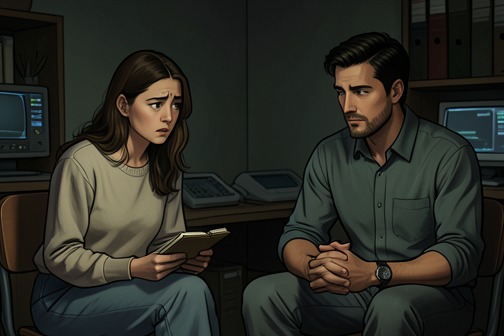
[Cassie’s betrayal at Trinity](entity:event-recall-event-cassie-s-betrayal-at-tr-d5c49a245946) is the experience [Cassie Maddox](entity:character-recall-character-cassie-maddox-309104c455a6) recounts to [Rob Ryan](entity:character-recall-character-rob-ryan-18e1297f6a56) to explain why she left college: after nearly two years of a close but controlling friendship, a classmate retaliated against her rejection by falsely telling others that she had threatened to accuse him of rape. The story traces how private manipulation became public ostracism, and how the failure of her classmates to believe her drove her away.
## Friendship and Control
Cassie says that in her second year she befriended a popular, attractive, charming and intelligent classmate. They skipped classes and spent hours together over coffee; he brought her inexpensive, sometimes apparently used presents, while other students regarded their closeness as sweet. Cassie was flattered by his attention, though she says she was not romantically interested in him. She knew he lied, often without an apparent reason, but attributed this to his account of a terrible childhood and being bullied. At eighteen or nineteen, she believed that steadfast friendship might make him feel secure enough to stop lying.
The friendship gradually narrowed Cassie’s world. Her classmate sulked when she spent time with other friends, and his unpredictable shifts between affection and cold disapproval left her repeatedly trying to work out what she had done wrong and apologizing. His small acts of deception and provocation—including borrowing her lecture notes before exams, claiming to have lost them, and then reacting indignantly when she saw them in his bag—angered her, but his intermittent warmth kept her from ending the friendship. She did not want to hurt him, even as the relationship was making her increasingly confused and estranged from other people.
## Rejection and the False Story
In January of her fourth year, after almost two years of friendship, the classmate made a pass at Cassie Maddox in her flat. Although she was by then so confused that she says she barely knew what she was doing, she refused him and said she wanted them to remain friends. He appeared to accept her answer; they talked, and he left. The apparent calm of that exchange made the reversal the next day all the more disorienting: when Cassie went to class, her classmates stared at her and no one would speak to her.
It took Cassie two weeks to discover what had happened. She eventually cornered Sarah-Jane, a former first-year friend, who told her that the others believed Cassie had wronged the classmate. On the night Cassie rejected him, he had gone to the flat of other women in their class in tears. He represented himself as someone who had secretly been dating Cassie and had decided to end the relationship; he then claimed that she had threatened to accuse him of rape, go to the police and the papers, and ruin his life. In this account, the threatened accusation was invented, but it gave his rejection a public narrative in which he could appear endangered and Cassie culpable.
Cassie tried to correct the story, telling everyone who would still speak to her what had actually happened. None believed her. Her classmates and mutual acquaintances sided with him, including people she had regarded as friends, turning a private refusal into an almost total social expulsion. The betrayal was not only the classmate’s lie: it was the collective decision to accept it, while Cassie’s own account of the encounter was discounted.
## Threat, Departure, and Aftermath
Cassie’s account moves from social punishment to direct intimidation. After she stayed at college for a few more weeks, the classmate remained surrounded by women who offered him protective pats and glared at her. Some confronted Cassie with the claim that she was helping real rapists escape accountability; one told her she deserved to be raped. Their response made the false story more than a reputational injury: it turned the people around her into a chorus that treated her as the aggressor and sexual violence as a punishment she had earned.
The classmate then staged a public accusation in the Buttery. With his supporters trying to stop him, he approached Cassie loudly and pretended she had been ringing him in the middle of the night. When she denied it, he privately suggested that if he broke into her flat and raped her, the charges would not stick. The public performance preserved his image as the wronged party; the quiet threat exposed the menace beneath it. Cassie later judged that he was unlikely to carry it out, reasoning that keeping her uncertain was more entertaining to him than acting. She had good locks and kept her gun beside her bed, but the threat had already made ordinary safety feel conditional.
The experience frightened Cassie enough that she left college. She went to France, stayed for a year with cousins in Lyons, and worked as a waitress in a café; there she acquired her Vespa. When she returned, she applied to Templemore. Looking back, she allows that the classmate was probably the reason for this abrupt change of direction, while also identifying a hard-won consequence: she believed she had become unusually alert to psychopathic behavior, as if one exposure had left her hypersensitized.
The injury persists in a small later encounter. The previous year, Cassie met Sarah-Jane in a pub in town and greeted her. Sarah-Jane said the classmate was doing well, adding that this was despite Cassie’s best efforts, and walked away. The remark repeats the old accusation in miniature: even after time and distance, the social version of events still casts Cassie as the one who caused harm. Her story to Rob Ryan therefore explains not only why she left college, but why betrayal by a group that had once included her friends remains inseparable from the threat itself.
## The Disclosure and Its Frame
Cassie tells the story during a private conversation with Rob Ryan, after he has begun speculating aloud about psychopathy. She cuts him off and asks him to listen, then brings him his drink and moves to the window with hers. Her controlled manner does not conceal the strain: she swallows hard, struggles to light a cigarette, and holds herself with a rigidity Rob recognizes as unlike her usual composure. The disclosure’s weight lies partly in that contrast. Cassie had previously spoken of being stabbed without visibly tensing; this memory makes the cost of the college experience legible through gestures she cannot quite control.
Rob initially fails to understand why she is telling him this story at that moment. In retrospect, he recognizes that she was communicating something specific, but his account does not name its precise meaning. That gap makes the disclosure a scene of missed understanding as well as trust: Cassie opens a previously unshared part of her past, while the listener only later realizes that its relevance was immediate. Her attempt to speak plainly is surrounded by signs of how difficult the subject remains, including the cigarette she lights from the end of another and the brief, harsh laugh with which she describes what happened.
Event 11
Sandra Scully rape case
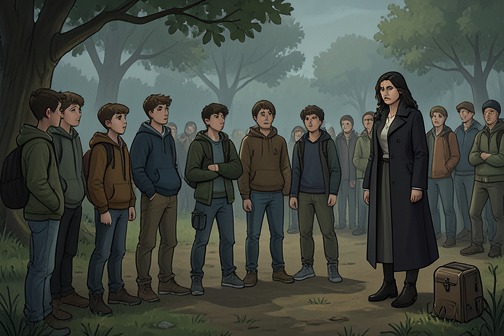
The [Sandra Scully rape case](entity:event-recall-event-sandra-scully-bc66f33be17f) is a past assault that becomes newly consequential during the investigation into the disappearance of [Peter Savage](entity:character-recall-character-peter-savage-a032081bc460) and [Jamie Rowan](entity:character-recall-character-jamie-rowan-1e76ac362340). Revisited in an interview with [Jonathan Devlin](entity:character-recall-character-jonathan-devlin-79c023bbdeb3), it brings together an unresolved crime, children who may have witnessed something in the woods, and a disputed cinema alibi. The questioning raises the possibility that Jonathan feared what the children knew, but it does not establish that he committed the assault or resolve the conflicting accounts.
## Reopened During the Investigation
The assault enters the narrative not through a direct account from [Sandra Scully](entity:character-recall-character-sandra-scully-185d04c9c6be), but through [Cassie Maddox](entity:character-recall-character-cassie-maddox-309104c455a6)’s questioning of Jonathan. She returns to it as the beginning of a sequence of events relevant to the children’s disappearance. That order matters: the old case is not treated as a separate historical inquiry. Its possible witnesses may connect it to the later danger surrounding Peter Savage and Jamie Rowan.
The conversation shifts the investigation from a field of competing possibilities toward a more specific suspicion about Jonathan. [Rob Ryan](entity:character-recall-character-rob-ryan-18e1297f6a56) reflects that Jonathan has, in effect, indicated that he knows something. The discovery is not a confession to the rape. Rather, it is the investigators’ growing sense that the old assault and the children’s presence in the woods cannot be considered independently.
## Timing and the Cinema Account
Asked when the assault took place, Jonathan says it was in the summer of [1984](entity:time-recall-time-1984-db6e36e8c14e) but cannot give a date. Cassie notes that statements place it within the first two weeks of August; Jonathan allows that this could be right. His uncertainty leaves the timing imprecise, while the statements provide a narrower period against which the investigators can test his account.
Cassie also tells him that they have statements indicating there were witnesses. She puts to him an account in which he chased children into the woods and returned with a dismissive remark about them. Jonathan says he does not remember knowing they were there. The exchange presents the alleged encounter as an investigative claim, not as a fact he accepts: the possibility that children saw or heard something is central, but his response remains denial or lack of memory.
The interview also tests Jonathan’s claim about going to a cinema in [Stillorgan](entity:location-recall-location-stillorgan-05ef8cfa2189) with [Cathal Mills](entity:character-recall-character-cathal-mills-d951bf7aa723) and [Shane](entity:character-recall-character-shane-05621ac800e8). Cassie challenges whether he went there at all; Jonathan says he did, and identifies the other two men as having gone with him. Later, Rob frames the cinema visit as a possible alibi provided by someone who was not actually at the scene. The two versions leave the alibi’s purpose and reliability contested rather than settled.
## Fear, Witnesses, and Credibility
Cassie’s account of the possible motive for keeping the children quiet distinguishes Sandra from the young witnesses. She argues that Jonathan and the others may have considered Sandra unlikely to report the assault: in her assessment, Sandra was attached to Cathal, and a prosecution could be weakened by the fact that she had previously had consensual sex with two of the assailants. Cassie describes the prejudice a rape complainant could face in court as part of that calculation. This is her argument during an interrogation, not an independent finding about what Sandra would have done.
The children, by contrast, are presented as a continuing threat to the men’s sense of safety because their testimony could expose them. Cassie’s questioning thus proposes a connection between the assault and the children’s disappearance: if the children had witnessed the men in the woods, they might have known something that made them dangerous to those involved. The proposed connection explains the investigators’ line of inquiry, but the evidence in the interview does not by itself prove that the children were harmed because of what they saw.
## Limits of the Case and Its Narrative Role
Rob briefly reassures Jonathan that the statute of limitations applies. He acknowledges, however, that the investigators had not actually checked it and considers the point moot because they would not be able to charge him. The exchange marks a practical limit on what the old case can yield as a prosecution, even as it remains important to understanding the present investigation.
Jonathan insists that he and the others did not touch the children, rejects the suggestion that they committed murders, and says he wants to know who killed [Katy Devlin](entity:character-recall-character-katy-devlin-0f044f95eda4). Cassie accepts that the interview can return to the children later and turns to [Katy](entity:character-recall-character-katy-670ee7b5b514)’s death. The movement between cases leaves the Sandra Scully rape case unresolved in the available account. Its significance lies in the way it reframes the woods as a place where an earlier crime may have acquired witnesses—and where the investigators suspect that fear of exposure could connect separate harms—without supplying a final verdict on Jonathan’s role.
Event 12
Peter Savage and Germaine Rowan disappearance case
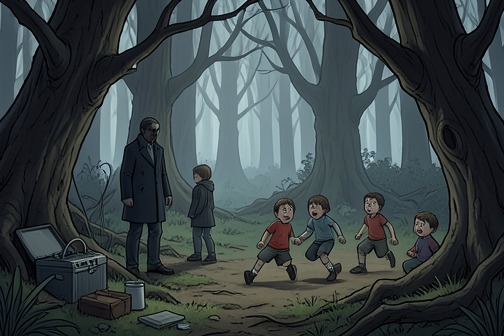
[Peter Savage](entity:character-recall-character-peter-savage-a032081bc460) and [Germaine Rowan](entity:character-recall-character-germaine-rowan-843fd5768f20) disappeared from [Knocknaree](entity:location-recall-location-knocknaree-d62cd5a36cda) in [1984](entity:time-recall-time-1984-db6e36e8c14e), leaving their families without the certainty of death or the possibility of a settled farewell. Their disappearance becomes more than a parallel tragedy in the investigation of [Katy Devlin’s murder](entity:event-recall-event-katy-devlin-s-murder-720ac140d640): forensic evidence connects the cases, while the long absence of [Peter](entity:character-recall-character-peter-22e18a2305ec) and Germaine exposes what it means for a community to be unable to close a loss. The case is recalled through [Rob Ryan](entity:character-recall-character-rob-ryan-18e1297f6a56)’s uncertain memories of the wood and through the investigators’ reconstruction of what happened there; its central fact remains an absence that has endured for decades.
## Background and Disappearance
A few days after the rape of [Sandra Scully](entity:character-recall-character-sandra-scully-185d04c9c6be), Peter and Germaine vanished. In [Knocknaree wood](entity:location-recall-location-knocknaree-wood-26139c5265ab), Rob’s recovered recollections place the children’s earlier play among faint trails, a twisted apple tree, and small clearings. He remembers that he and the others watched [Jonathan Devlin](entity:character-recall-character-jonathan-devlin-79c023bbdeb3) and his friends assault Sandra. He cannot fix the exact place where Peter and Germaine disappeared: perhaps it was where he stood, perhaps somewhere nearby. The wood returns not as a map that resolves the event, but as a landscape in which recognition repeatedly approaches and then slips out of reach.
Rob’s account also associates the disappearance with [Adam Ryan](entity:character-recall-character-adam-ryan-722038688481)’s own loss from the area. Adam’s parents moved away because of the publicity and fear that whoever had taken the children might come back for him. They withdrew from public view, and Adam grew up living with the consequences of what happened. The evidence distinguishes his fate from Peter and Germaine’s: Adam survived, but could not return to the community he had known. His absence therefore became another lasting measure of the damage caused by the case, not an answer to the question of what happened to the missing pair.
## The Case Reopened by [Katy Devlin](entity:character-recall-character-katy-devlin-0f044f95eda4)’s Murder
Years later, the investigation of Katy Devlin’s murder gives the old disappearance new evidentiary force. [Cassie Maddox](entity:character-recall-character-cassie-maddox-309104c455a6) tells Jonathan Devlin that forensic evidence links [Katy](entity:character-recall-character-katy-670ee7b5b514)’s death to the 1984 disappearances of Peter Savage and Germaine Rowan. The connection points toward a murderer who is local, knows Knocknaree intimately, and is probably at least thirty-five, with strong ties to the area extending back more than twenty years. Many men who fit that description have alibis, narrowing the field. The old case thus changes the present inquiry: it is no longer only a search for a killer in Katy’s death, but an investigation into a pattern reaching back to the children who vanished.
Cassie also rejects the assumption that the offender must be a habitual or eager killer. Her theory is that he did not want to commit the crime and felt compelled to do so. Rob supports that profile in questioning [Damien Donnelly](entity:character-recall-character-damien-donnelly-53edf227b71e), arguing that someone who commits an act he cannot live with may eventually confess. Damien’s response is not, by itself, proof of the disappearance case’s solution; the interrogation material establishes the investigators’ working theory and pressure strategy, not a complete account of Peter and Germaine’s fate. The distinction matters because the forensic link makes the cases relevant to one another without making every uncertainty disappear.
## Witnesses and Limits of Testimony
[Jessica Devlin](entity:character-recall-character-jessica-devlin-ea876c49a0f5)’s halting evidence illustrates how difficult it is to turn remembered fragments into a dependable chronology. Earlier, she says that a man frightened Katy; later, she identifies a man who spoke to Katy on the road while Jessica and Katy were returning from a shop. When asked to place the encounter in time, Jessica corrects the suggestion that Katy had gone away, saying that Katy had been killed, then loses her focus. These statements concern a possible lead in Katy’s case; they do not establish that the man was responsible for Peter and Germaine’s disappearance.
[Rosalind Devlin](entity:character-recall-character-rosalind-devlin-b7ac8dc19b99) attempts to supply or prompt Jessica’s account, but Rob insists that the investigators need to hear the information directly from Jessica because [Rosalind](entity:character-recall-character-rosalind-239002ff9e41)’s version would be hearsay and inadmissible in court. Jessica’s dependence on prompting, followed by her withdrawal, leaves the testimony fragmentary. The episode sets a procedural limit beside the emotional urgency of the investigation: a clue may matter, but an adult’s retelling cannot simply substitute for a child witness’s own admissible account.
## The Families’ Continuing Loss
Cassie makes the duration of the disappearance tangible by naming the people still living around it. Peter had been regarded as a natural leader and might, she says, have led the [Move the Motorway campaign](entity:organization-recall-organization-move-the-motorwa-3ab772ace9b1) had he lived. His parents could not bring themselves to move house. Peter’s father, Joseph Savage, once received an offer of his dream job in Galway, but the family could not bear the thought that Peter might someday return and find them gone. Their refusal to leave keeps open the possibility that has governed their lives: that he may come home.
Germaine, also known as [Jamie](entity:character-recall-character-jamie-9ab1c29c9c6f), had wanted to become a vet. Her mother, Alicia Rowan, has left her room untouched and dusts it every Saturday. When telephone numbers changed to seven digits in the 1990s, Alicia pleaded with Telecom Éireann to let her keep the old six-digit number in case Jamie tried to call. These routines do not solve the case; they show how the missing person remains present in a household organized around waiting.
Cassie contrasts those families’ unresolved hope with Jonathan Devlin’s grief after Katy’s death. The Savages and Alicia Rowan, she tells him, envy the certainty of being able to bury a child: they have endured the same fear that Katy was missing, but for twenty years. The comparison does not equate the losses. It reveals the particular cruelty of disappearance, which denies families both a return and a confirmed ending. Peter and Germaine’s case remains tied to the present investigation by forensic evidence, while its human consequences continue in rooms preserved, addresses retained, and families unable to stop waiting.
Event 13
Katy Devlin murder at the excavation site
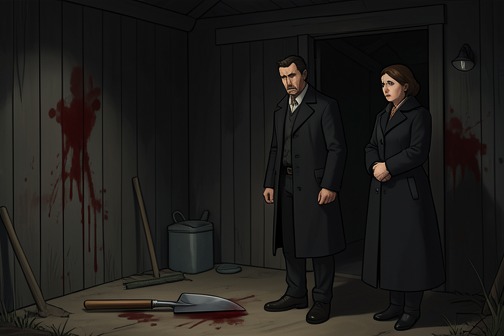
[Katy Devlin’s murder](entity:event-recall-event-katy-devlin-s-murder-720ac140d640) at the excavation site becomes legible through two converging lines of evidence: a history of unexplained illness that raises suspicion of poisoning, and a missing archaeological trowel and blood traces that locate the killing in the finds shed. The investigation links the family’s unanswered questions about [Katy](entity:character-recall-character-katy-670ee7b5b514)’s illness to a specific sequence at the dig, but the evidence presented here does not identify the murderer or resolve every uncertainty about access to the sheds.
## Background and Suspicion
During questioning, [Jonathan Devlin](entity:character-recall-character-jonathan-devlin-79c023bbdeb3) insists that he does not know what happened to the children who disappeared years earlier and says his concern is finding out who killed Katy. The investigators temporarily set that earlier matter aside and turn to Katy’s medical history. Her records show four years of unexplained gastric illness, ending in the spring, when she told her ballet teacher that it would stop and then recovered. The medical examiner found no sign of an underlying condition that would explain the illness.
[Cassie Maddox](entity:character-recall-character-cassie-maddox-309104c455a6) presents poisoning as the investigators’ explanation for that pattern. The inference rests not on a named poison recovered from Katy, but on the contrast between years of illness and its sudden end, together with the medical examiner’s findings. She argues that the person responsible would have needed regular access to Katy and her trust. Katy had been given another chance at ballet school, and Cassie suggests that her refusal to continue taking whatever had made her ill may have threatened to expose the arrangement. A few months later, Katy was dead. These details make her illness part of the murder investigation rather than a separate medical mystery, while the proposed connection remains an investigative case rather than a finding established by the medical record alone.
Jonathan’s response changes the investigators’ reading of the exchange. As Cassie describes Katy’s illness and the possibility of poisoning, the anger leaves his face and he turns visibly pale. [Rob Ryan](entity:character-recall-character-rob-ryan-18e1297f6a56) interprets this reaction as recognition: Jonathan knows something. Ryan then asks whether Jonathan is protecting his wife, [Margaret Devlin](entity:character-recall-character-margaret-devlin-ba0e5d595195), and offers help if the family’s effort to remain together is the reason for his silence. Jonathan replies that Margaret loves their daughters, but the exchange ends before he completes his defense. The scene raises the possibility of family knowledge without establishing that Margaret poisoned Katy or that Jonathan knew who killed her.
## The Missing Trowel and the Shed
The investigation later focuses on a missing tool from the excavation site. On the night Katy died, a trowel disappeared from the locked finds shed. It had a leaf-shaped metal blade fixed to a wooden handle five or six inches long, narrowing toward the blade and rounded at the end. The handle bore the burned initials of its owner, [Sean Callaghan](entity:character-recall-character-sean-callaghan-be9ab2383dba), who said he had left it in the shed at five thirty on Monday evening and forgotten it. [Dr. Cooper](entity:character-recall-character-dr-cooper-a0d068e0f3f9)’s description of the implement used in the assault matched the trowel.
Because the trowel’s presence in the finds shed was not expected, Rob Ryan treats it as a possible weapon of opportunity and the shed as a possible primary crime scene. The distinction matters: the tool’s disappearance and its match to the description give investigators a route into reconstructing events, but do not by themselves establish who took it or when it was used. Ryan directs [Sophie](entity:character-recall-character-sophie-32e718e90b39) and her forensic team to begin their examination in the finds shed.
Access narrows the inquiry without immediately settling it. [Ian Hunt](entity:character-recall-character-ian-hunt-b40e07892ead), [Mark Hanly](entity:character-recall-character-mark-hanly-a7c496e2e8a4), and [Damien Donnelly](entity:character-recall-character-damien-donnelly-53edf227b71e) had keys to the finds shed. The investigators cannot rule out Callaghan, since his account of leaving the trowel there might be false. Hunt and Hanly had cars, so either could have transported or concealed Katy’s body in a vehicle. Callaghan and Donnelly were not known to have cars, which led Ryan to consider a nearby hiding place, probably on the site, if one of them was involved. These are conditional lines of inquiry, not conclusions about any individual’s guilt. The team searches for the trowel, a bloodstained plastic bag, and evidence of both a primary and a secondary crime scene.
## Forensic Confirmation and Reconstruction
The physical examination supplies the decisive change in the inquiry. Luminol reveals patterns on the finds-shed floor and lower shelving. Although the chemical can produce false positives, including from household bleach and copper, Sophie has the floor swabbed and confirms that the substance is blood. Rob Ryan realizes that Katy died in the shed where the team had already interviewed the killer. The finding transforms the shed from a plausible location into a confirmed crime scene, even though the identity of that interviewee is not disclosed in this account.
The investigators later tell Damien Donnelly that evidence from two sheds supports a more specific sequence: Katy was killed in the finds shed on Monday night and kept in the tools shed through Tuesday. There was no forced entry. The timing and movement between the sheds distinguish the place of death from the place where the body was concealed afterward. When Damien asks whether the investigators have found something in a shed, Ryan confirms that they found evidence in two, but withholds details. He explains that the absence of forced entry points toward someone with a key and names Mark, Dr. Hunt, or Damien as the possibilities under consideration; Hunt, Ryan adds, has an alibi.
## Significance and Limits of the Evidence
The murder’s reconstruction proceeds by joining circumstantial and physical clues without treating them as interchangeable. Katy’s illness suggests a prolonged betrayal by someone with access to her; the missing trowel connects the excavation site to the assault; confirmed blood establishes the finds shed as the place of death; and evidence from the tools shed extends the sequence into Tuesday. Each discovery sharpens the account of what happened while leaving the question of responsibility open in the scenes covered here.
The sheds also give the investigation a concrete structure. A locked room, a tool whose owner says he forgot it, a small group of keyholders, and evidence of movement between two work spaces turn the site into a set of testable questions about access and timing. The case moves from the apparent privacy of Katy’s illness to the material traces of a crime committed within the excavation complex. Its central reversal is that the sheds where workers stored tools and finds had also preserved evidence of Katy’s death and concealment.
Event 14
Jonathan Devlin’s police interrogation
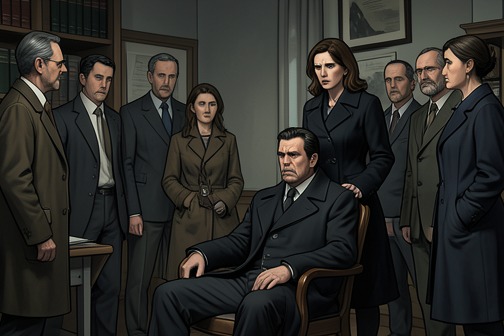
[Jonathan Devlin’s police interrogation](entity:event-recall-event-jonathan-devlin-b597d5dc6126) brings the investigation’s competing strands—[Sandra Scully](entity:character-recall-character-sandra-scully-185d04c9c6be)’s rape, the disappearance of children from [Knocknaree](entity:location-recall-location-knocknaree-d62cd5a36cda), and [Katy Devlin](entity:character-recall-character-katy-devlin-0f044f95eda4)’s death—into one room. Jonathan provides a limited admission about his movements in [1984](entity:time-recall-time-1984-db6e36e8c14e), but no confession or charge follows. The interview’s decisive turn is less a conclusive answer than the investigators’ conviction that he is withholding something, a certainty that culminates in [Rob Ryan](entity:character-recall-character-rob-ryan-18e1297f6a56) abandoning professional restraint and [Cassie Maddox](entity:character-recall-character-cassie-maddox-309104c455a6) having to intervene.
## Witness Leads and the Interview’s Opening
Before questioning Jonathan, the detectives had been trying to establish what [Jessica Devlin](entity:character-recall-character-jessica-devlin-ea876c49a0f5) knew about a man who had spoken to [Katy](entity:character-recall-character-katy-670ee7b5b514). Jessica had first said that the man frightened Katy, then withdrawn into silence when asked to explain. When the detectives later sought her account directly, [Rosalind Devlin](entity:character-recall-character-rosalind-devlin-b7ac8dc19b99) began to supply what Jessica had told her. Rob stopped her: Jessica herself needed to speak, because [Rosalind](entity:character-recall-character-rosalind-239002ff9e41)’s account would be hearsay and inadmissible in court. The distinction matters in the later interview: suspicion and family accounts may direct questioning, but they do not by themselves establish what happened.
With Rosalind prompting her, Jessica eventually said that she had seen a man talk to Katy on the road as they returned from the shop. Asked when this had happened, she corrected Rob’s phrasing: Katy had not gone away; Katy had been killed. The exchange established a possible lead, not an identification. Jessica did not provide the man’s name or a date, and her attention soon drifted away again. Her uncertain testimony forms part of the case’s background, but it does not itself connect Jonathan to the stranger.
The detectives brought Jonathan into an interview room and formally cautioned him. Rob clarified that the caution was routine and that Jonathan was not under arrest; they wanted an update and his help. Jonathan’s sharp question about whether he was being arrested, and his attention to the wall of photographs, made the exchange tense from the outset. The interview then moved from the rape of Sandra Scully to Jonathan’s account of events in 1984 and, finally, to Katy’s illness and death.
## The 1984 Account and the Missing Children
Cassie began by asking when Sandra Scully had been raped. Jonathan placed it in the summer of 1984, without recalling a specific date. Rob told him that the statute of limitations applied, although the detectives had not checked the point; in any case, they had no prospect of charging him for that rape. The assurance kept the questioning focused on what Jonathan might disclose rather than presenting the old case as a charge they could bring.
Cassie challenged his account of being in [Stillorgan](entity:location-recall-location-stillorgan-05ef8cfa2189). She proposed that a cinema visit could have provided an alibi, and argued that the number of assailants mattered to how the three children could have been subdued. Rob offered Jonathan a distinction between being a murderer and being an accessory, invoking [Cathal Mills](entity:character-recall-character-cathal-mills-d951bf7aa723)’s claim that Jonathan would not have devised the plan. These were investigative theories and pressure points, not facts established by the interview.
Jonathan then conceded that he had gone to Stillorgan with Cathal Mills and [Shane](entity:character-recall-character-shane-05621ac800e8) to see a film. He maintained that this was what he had told police at the time. The admission confirmed that he had been with the other two men in Stillorgan, but did not establish that he had participated in the children’s disappearance or that the cinema visit was an alibi. When challenged, he denied that any of them had touched the children, said he knew nothing about what had happened to them, and insisted that he wanted to know who had killed Katy. The case’s central uncertainty therefore remained: Jonathan’s account placed him alongside men implicated in the old investigation, but his own words neither resolved his role nor supplied an explanation for the missing children.
## Katy’s Illness and the Detectives’ Suspicion
Cassie shifted the interview to Katy’s medical history. She described four years of unexplained gastric illness, ending in the spring after Katy received another chance at ballet school, and noted that the medical examiner had found no sign of disease. Cassie interpreted the pattern as evidence that someone had poisoned Katy, suggesting substances that could produce illness and emphasizing that a person with daily access to Katy could have harmed her without attracting suspicion. She further proposed that Katy had stopped taking something and might have threatened to tell. These were Cassie’s deductions from the records and timing, not a confession by Jonathan or a conclusion proven in the room.
Jonathan’s visible reaction strengthened the detectives’ suspicion: the flush left his face, and Rob read his pallor as evidence that he knew something. The interrogation thus distinguishes between proof and conviction. The medical history gave Cassie a reasoned theory about prolonged poisoning, while Jonathan’s response appeared significant to the detectives; neither, on its own, demonstrated that Jonathan had poisoned Katy or knew who had. The unresolved gap between what they believed and what they could establish sharpened Rob’s frustration.
## Loss of Control and Release Without Charge
Rob’s anger broke through during the questioning. He knew the evidence would not hold Jonathan and believed that Jonathan might leave without facing consequences, yet felt certain of his guilt. Rob lunged at him. Cassie intervened and restrained him, turning what had often been a rehearsed pressure tactic between the detectives into a real struggle. Rob’s own account emphasizes that this occasion was different: he was no longer performing a controlled feint to unsettle a suspect, but acting on his desire to attack Jonathan. The moment exposes the danger in treating intimidation as a routine investigative instrument, especially when personal certainty outruns admissible proof.
After separating them, Cassie resumed the interview with professional composure. She told Jonathan that he would be released without charge for the time being, advised him to remain somewhere the police could find him, and warned him not to contact Sandra Scully. Jonathan accepted the terms and left. His release did not clear him of suspicion, but it made the practical limit of the interrogation unmistakable: the detectives had drawn a connection between the old rape, the missing children, and Katy’s case, yet had not secured evidence sufficient to arrest him. Rob was left to confront not only the failure to obtain an answer but also his own breach of control, and to wonder whether his state of mind was deteriorating.
Event 15
Rob Ryan’s nighttime return to Knocknaree Wood
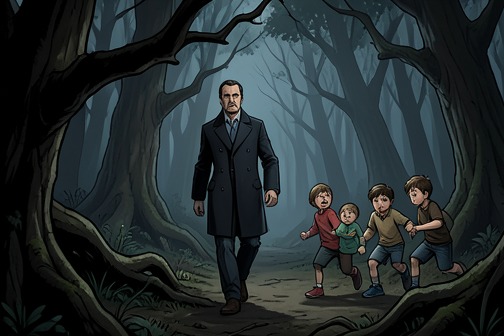
[Rob Ryan’s nighttime return to Knocknaree Wood](entity:event-recall-event-rob-ryan-knocknaree-ef5a4a8d6c9b) is a deliberate attempt to recover the childhood past he has kept hidden, but it ends not in an explanation of the [1984](entity:time-recall-time-1984-db6e36e8c14e) disappearances, but in panic and renewed loss. The episode makes the wood at once a place of remembered childhood and a source of danger: Rob follows a fragile thread of memory into it, then runs out as if he himself has become the quarry. Even he cannot determine whether what happened was recollection, dream, or hallucination.
## A return kept secret
Rob had concealed his connection to the [Knocknaree](entity:location-recall-location-knocknaree-d62cd5a36cda) disappearances throughout his adult life. He knew that his work on a case that might connect to the old one should have prompted him to inform O’Kelly. Instead, he kept silent: disclosure would likely remove him from the investigation because of the rule against working on a case involving personal emotional conflict, and would bring renewed questioning about his childhood in the wood. His earlier interviews had left him with a frightening impression of mental blankness, as though his mind had been wiped and replaced by an empty test pattern. Detectives had questioned him repeatedly over the years, first every few months during school holidays and later about once a year, before eventually stopping. Rob had regarded that cessation as sensible and saw no practical reason to reverse it.
His silence also held an element of self-dramatization. Rob recognized that carrying an unsuspected secret through the investigation appealed to both his ego and his taste for the picturesque: it let him imagine himself as an enigmatic maverick. The return therefore follows a long conflict between his knowledge that he should disclose his connection and his wish to keep it private. It is not an official investigative step, but a solitary effort to approach the memory on his own terms.
## Choosing the night and entering the wood
By the time Rob went back, he had begun trying to remember what had happened there. On sleepless nights he walked for hours through the city, sometimes coming to awareness in unfamiliar places without knowing how he had got there. The effort produced scattered childhood scenes rather than a coherent account: time with [Peter](entity:character-recall-character-peter-22e18a2305ec) and [Jamie](entity:character-recall-character-jamie-9ab1c29c9c6f), details of their neighborhood, and ordinary objects such as a school desk marked with old graffiti. Because Rob had long assumed that the first twelve years of his life were gone for good, even minor fragments felt powerful, though none by itself helped solve the case.
He saved the wood for Saturday night, choosing a time when [Sam](entity:character-recall-character-sam-d93f992a0ed0) O’Neill was away in Galway for a family christening and [Cassie Maddox](entity:character-recall-character-cassie-maddox-309104c455a6) and [Heather](entity:character-recall-character-heather-c102c98231de) had plans of their own. He brought a sleeping bag, torch, thermos of spiked coffee, and sandwiches. He brought nothing with which to light a fire: residents of the estate were on edge and might report an unexplained light to the police, and he did not trust himself not to set the remaining wood alight. The practical care of the preparations sits uneasily beside their childlike cast; packing made him feel like a boy running away from home.
Rob arrived around seven and crossed the archaeological site by the rough trails used by the archaeologists. The evening was clear and still. Slanting light turned the tower’s stone rose-gold, while the excavated trenches and earth heaps seemed ragged and desolate. He followed those tracks toward the wood, carrying his camping gear into a landscape already charged with the childhood past he hoped to recover.
## A memory begins to open
The attempt did not produce a controlled or complete recollection. Rob was so tired that he began to fall asleep in his sleeping bag. He then woke abruptly, sitting upright before he was fully conscious, after hearing a voice beside his ear. The lights in the estate had gone out; the wood was quiet, and a twig cracked somewhere nearby. The voice recalled a childhood moment when Peter, on a castle wall with Rob and Jamie, had suddenly stopped their play to ask what they had heard. The return thus brought back not only scenes of childhood, but the instant when their ordinary play gave way to alertness and the unknown.
As Rob kept trying to follow the memory, his body registered the strain: sweat soaked him beneath the sleeping bag, his back stiffened against the tree, and his head jerked in convulsions. In his mind, bright images of running with Peter and Jamie gave way to darkness and a faint, quick sound spreading through the wood. He tried to hold onto the thread of memory rather than lose it. The sounds grew closer, and something screamed on the far side of the wood. Darkness seemed to gather ahead of him; he thought he saw a large presence across the clearing and remembered a glimpse by the river of water flashing around golden, owl-like eyes.
The recovered past also included a far more disturbing scene: Rob remembered approaching a clearing with Peter and Jamie and seeing men assault [Sandra Scully](entity:character-recall-character-sandra-scully-185d04c9c6be). One held her arms, another her legs, while a third was on top of her; when she made choking sounds instead of screaming, one of the men struck her and she stopped. This memory gives the childhood mystery a concrete horror, but it does not furnish a complete account of what happened to the children afterward. In the later conversation with Cassie Maddox, Rob could remember entering the wood, what the children had been talking about, and hearing something before going to investigate; he could not remember what they heard, and the recollection ended in his own panic.
## Flight and immediate aftermath
Unable to keep still or make sense of the darkness, Rob tore himself out of the sleeping bag and ran away from the clearing. Brambles caught at his legs and hair; he collided with a tree, stumbled through hollows and undergrowth, and feared he would never get out. In that terror he imagined Cassie Maddox finding his sleeping bag among falling leaves. A glimpse of the new moon showed him that he had reached the archaeological site. He stumbled over uneven ground, struck his shin against an old wall, and kept running toward his Land Rover.
The escape changed his sense of his role. As a detective, Rob had taken for granted that he was the hunter; it had not occurred to him that he might have been the hunted. Yet even the physical evidence of his flight was uncertain to him: his jeans were smeared with mud, though he could not remember falling. At Cassie Maddox’s home, she quietly asked whether he had remembered something. Rob began to cry, an unusual response for him, and described the fragmentary recollection and the panic that cut it off. Cassie Maddox treated the recovery of any part of the afternoon as a significant step and expected that he might remember more next time, but the episode itself offered no such assurance.
## Uncertainty and lasting loss
Rob later stressed that during [Operation Vestal](entity:event-recall-event-operation-vestal-c37baedeac53) he was far from a normal frame of mind. He had entered the wood on very little sleep and less food, under accumulated tension and after drinking vodka. He could not rule out that the night’s events were a dream or a hallucination, and neither possibility comforted him. In the immediate aftermath, he slept for extraordinarily long stretches, while the memories and their stranger accompanying effects stopped abruptly. At first, he felt relief: anything connected with Knocknaree seemed like the worst possible news. Only later did he understand that the silence might represent not deliverance but a missed chance to recover his past.
During the long months afterward, Rob’s thoughts returned to Knocknaree despite his resolve to put it out of mind. By then, the memories he had laboriously recovered during the investigation had disappeared. Peter, Jamie, the men in the wood, Sandra, and the landscape itself survived only as remote, secondhand images, like scenes in old films; Rob feared that even those would eventually fade. One image remained: a summer afternoon when he and Peter lay in Peter’s front garden, trying unsuccessfully to make a periscope from an old comic’s instructions because they had rolled newspaper instead of using the required cardboard tube. The night return therefore marks both a brief opening in Rob’s childhood amnesia and a painful limit: the attempt brings him close to what he lost, but does not allow him to retain it.
Event 16
Rob Ryan and Cassie Maddox’s first intimate encounter
[Rob Ryan and Cassie Maddox’s first intimate encounter](entity:event-recall-event-rob-ryan-cassie-maddox-cc43329e295b) turns a trusted, apparently uncomplicated friendship into a relationship neither can return to unchanged. Its decisive movement is from unspoken closeness to a kiss, and then to Rob’s effort to call the night a mistake even as he admits that the old ease between them has become impossible.
## From Familiarity to Intimacy
The encounter begins in a setting of routine and care, not a declared romantic overture. Rob is so exhausted and unsettled that undressing feels too difficult; he climbs beneath the duvet still wearing his clothes. Cassie removes her sweater and settles beside him. Without consciously deciding to, he puts his arms around her, and she curls her back against him. Their good-night exchange remains affectionate and teasing, with Cassie telling him to wake her if he wants to.
After a long interval, Rob whispers to ask whether Cassie is awake. They lie still, and he registers the change between them as bodily intensity rather than as a clear decision: the air seems to shimmer, and he cannot tell whether his heart is racing or Cassie’s is pounding against his chest. He turns her in his arms and kisses her. After a moment, she kisses him back. The pause and the reciprocal response matter: the transition happens without a prior declaration, but it is not presented as a one-sided advance.
## Rob’s Retrospective Account
Rob later corrects his own account of himself. He recalls claiming that he always chooses the anticlimactic over the irrevocable, then acknowledges that this was a lie: at least once, he did not retreat from the irreversible choice. The confession makes the encounter a reversal in his self-understanding as well as a change in the friendship. His retrospective voice first casts him as someone who avoids decisive consequences, then preserves this night as the exception.
That correction also complicates the way he narrates the scene. Rob insists that neither of them knew what was coming, despite the expectations he imagines other people would have had. He remembers small, ordinary gestures—the way Cassie removes her hair clips and the way he tucks his socks into his shoes so she will not trip over them in the morning—as evidence of their familiar domestic ease. The intimacy grows out of that ease, but afterward those same habits no longer guarantee that the relationship can remain unchanged.
## The Morning After
Rob wakes first after what he estimates may have been only an hour or two of sleep. They do not get up until around three. Cassie, tousled and hungry, suggests their usual weekend pattern of a large Irish breakfast; Rob refuses. He cannot face either a conversation about the night or the tacit agreement that would come from avoiding it. The flat suddenly feels cramped, and he notices bruises and scrapes on his stomach, elbow, and thigh, including a deep gouge. The narration records these injuries without establishing their cause.
When Cassie offers him a lift, Rob sees a quick, startled flinch in her eyes and says he will take the bus instead. He finds his shoes under the sofa, makes a half-hearted attempt to wait, then gives up on the two buses and Sunday schedules. Rather than go near [Knocknaree](entity:location-recall-location-knocknaree-d62cd5a36cda) while the archaeological site might be deserted, he walks toward home by way of [Sandymount Strand](entity:location-recall-location-sandymount-strand-0d0e522cd261), stopping for bad-tasting coffee at a petrol station. He expects [Heather](entity:character-recall-character-heather-c102c98231de) to be home and imagines the questions she will ask about his muddy jeans and the missing car. His walk stretches the separation from Cassie into a period of anxious reckoning.
## A Friendship That Cannot Reset
On the way home, Rob decides that sleeping with Cassie was one of the biggest mistakes of his life. He cannot use either familiar response to an intimate entanglement: formally beginning a relationship or cutting off communication. Cassie is his partner at work, and he recognizes that a romantic relationship would bring responsibilities he feels unable to manage while he is already struggling to eat, sleep, and function in the investigation. He also knows that the police regulations make such a relationship an additional complication.
The loss he anticipates is more intimate than a change of status. He can no longer stay up drinking with Cassie, tell her about other women, or sleep on her sofa while seeing her simply as a close friend. Even a remembered gesture—the unthinking way she reached into his coat pocket for his lighter in the castle gardens—now belongs to a shared landscape charged with implications. The encounter does not erase their history; it makes their ordinary habits newly difficult to interpret.
When Rob later tells Cassie that Saturday night was a mistake and that they are stuck with what happened, she responds that it need not be a mistake. He insists that it should not have happened and attributes it to his being in a bad state over other matters. Her reply and his refusal leave their disagreement unresolved: he tries to turn the event into an error that can be contained, while she resists treating that judgment as inevitable. The encounter’s consequence is therefore not a settled romance or a clean return to friendship, but a changed bond whose meaning they do not share.
Event 17
Sam O’Neill discovers his uncle’s secret dealings with Terry Andrews
[Sam O'Neill](entity:character-recall-character-sam-o-neill-050c4eebaac4) discovers that his uncle [Red](entity:character-recall-character-red-73ac9042bc8e) is connected to [Terry Andrews](entity:character-recall-character-terry-andrews-cac05c12eb4b) through a recorded late-night call about money, land, and political arrangements. [Rob Ryan](entity:character-recall-character-rob-ryan-18e1297f6a56) recognizes the voice on the tape; [Sam](entity:character-recall-character-sam-d93f992a0ed0) then confirms who it is and reports the discovery to [O'Kelly](entity:character-recall-character-o-kelly-434097b87446). The revelation does more than identify a voice: Andrews's accusations suggest a compromised land-development arrangement, while O'Kelly's response puts Sam under pressure to suppress the evidence rather than pursue it.
## The Recording and Its Contents
The discovery comes while Sam is reviewing recorded calls. His work has brought him to a point of frustration: with only a week left on the assignment, he wonders whether the material will amount to anything beyond calls about dating and food. Then the tape clicks to a late-night call from an unregistered mobile. A deep male voice answers shortly before two in the morning, and Andrews quickly turns the exchange into an angry argument.
Andrews complains that arrangements should have been back on track by then, but that injunctions are obstructing them. The other man tells him to calm down and insists that he still has matters under control. Andrews rejects that reassurance. He says he paid thousands of pounds, including money for a new councillor, and accuses the other man of taking his money and leaving him with land he considers worthless. He is especially alarmed that the police appear to know the land belongs to him. The argument therefore connects the call to Andrews's land interests and to payments he says were intended to secure help with the scheme. The recording establishes what Andrews alleges; it does not independently verify every accusation.
## Recognizing the Voice
At first, the speaker's identity is not stated. Rob hears a familiar timbre, accent, and pattern of inflection beneath the caller's usual abrasive manner. He realizes that he has heard the voice regularly, in ordinary life, and asks Sam whether the caller might be his uncle. Sam confirms it after a pause. His quick, shallow breathing registers the personal weight of the recognition, while the empty doorway offers no interruption or alternative explanation.
The recognition changes the call from a lead about Andrews into a family disclosure. Red is not merely someone whose voice sounds familiar: Sam identifies him as his uncle, and the substance of the call places him in conversation with Andrews about payments and stalled arrangements. The revelation is particularly disruptive because the evidence arrives through Sam's police work, not through a family conversation. The recording gives him a basis to confront what he has heard, but doing so would also mean challenging a relative he had not expected to find implicated.
## Sam Reports the Evidence
Sam says he thought about the recording over the weekend but did not call his uncle. Instead, he takes the tape to O'Kelly and tells him that the man speaking with Andrews is Red. His choice makes the discovery consequential beyond the immediate shock: Sam brings the evidence to a superior rather than quietly keeping it or going directly to his uncle. Rob is impressed that he follows through, although the next part of the meeting gives Sam little reason to feel supported.
O'Kelly tells Sam to erase the recording, end the phone tap, and leave Andrews alone. He argues that the police have no evidence connecting Andrews to the murder and warns that taking the matter further could damage both their careers. The warning is framed as an order and a threat of eventual professional isolation, not as an invitation to test the evidence. O'Kelly also insists that the conversation never happened because the tape never happened. Sam interprets this as an attempt to make him cover the matter up. His disillusionment is sharpened by the fact that he had not imagined this response among the possibilities he feared.
## Consequences and Significance
The event leaves Sam facing two connected conflicts: the evidence implicates his uncle in Andrews's dealings, and his superior directs him to destroy that evidence. Sam has not confronted Red, but he has disclosed the identification to O'Kelly, making his decision an act of professional reporting rather than a private accusation. The tape's contents remain allegations, yet the order to suppress it means the obstruction itself becomes part of what Sam must reckon with.
The scene also turns a technical record into a test of loyalty and authority. The caller's voice first registers as a familiar sound; once named, it links family intimacy to the investigation's account of land, money, and influence. O'Kelly's demand does not resolve whether Andrews's accusations are true or whether the uncle's conduct is criminal. Instead, it places Sam between the duty to preserve and report evidence and the pressure exerted by the institution he serves. The discovery's decisive outcome is therefore not a completed case against Andrews, but Sam's recognition that following the recording may require him to disobey an order from within the police.
Event 18
Discovery of the archaeological trowel and the crime scene in the tool shed
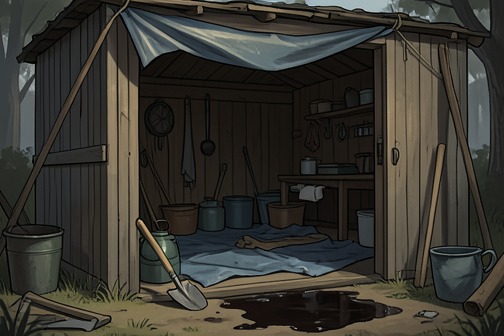
The discovery of the missing archaeological trowel and the crime scene in the tool shed is the turning point at which [Rob Ryan](entity:character-recall-character-rob-ryan-18e1297f6a56)’s investigation of [Katy Devlin](entity:character-recall-character-katy-devlin-0f044f95eda4)’s death moves from suspicion to physical evidence. A recollection about an unaccounted-for tool leads him to [Sean Callaghan](entity:character-recall-character-sean-callaghan-be9ab2383dba), then to a coordinated search of the [Knocknaree](entity:location-recall-location-knocknaree-d62cd5a36cda) dig. The search recovers the trowel hidden beneath tarpaulins; luminol testing in the separate finds shed then reveals blood and establishes that [Katy](entity:character-recall-character-katy-670ee7b5b514) died there. Together, the discoveries connect an everyday object to the crime and expose the investigators’ earlier proximity to its scene.
## The missing trowel and Sean Callaghan’s account
Rob’s lead comes to him as he is leaving the archaeological site. He has just watched the tension between [Mark Hanly](entity:character-recall-character-mark-hanly-a7c496e2e8a4) and Macker subside, and the other archaeologists have returned to work. As Rob buttons his coat, he suddenly remembers the trowel: the missing tool may be relevant to the crime. The realization changes his purpose at the dig. Rather than leave, he seeks out Sean Callaghan and asks whether Sean ever found his trowel. Sean says he had to buy another one, and Rob presses him for the last time he remembers having it.
Sean traces the loss to the finds shed. He had found a coin and carried it there on his trowel to show Dr. Hunt, because he understood that handling an old coin could damage it. Dr. Hunt consulted books to identify the find, and Sean left at about half past five without taking the trowel with him. At first, Rob understands Sean to mean that this happened on the Thursday the investigators came to speak with Mark. That timing would make the lead much less useful, and Rob feels his confidence drain away.
Sean corrects the chronology. The coin and the forgotten trowel date from an earlier Monday; the Thursday visit was merely the first time he needed the tool after leaving it behind. In the intervening period, the team had been mattocking a drainage ditch, and Sean assumed someone had picked up the trowel and failed to return it. When he finally needed it, his colleagues denied seeing it. The distinction between the Monday when the trowel vanished and the Thursday when Sean noticed its absence places the loss on the evening Katy Devlin died, giving Rob a reason to reopen the question of where the tool went.
## The search of the archaeological site
Rob calls [Sam O'Neill](entity:character-recall-character-sam-o-neill-050c4eebaac4) from the road, presenting the call casually while he waits for [Sam](entity:character-recall-character-sam-d93f992a0ed0) to answer. He asks for Sam, [Cassie Maddox](entity:character-recall-character-cassie-maddox-309104c455a6), several other investigators, and a team from the [National Bureau of Criminal Investigation](entity:organization-recall-organization-national-bureau-b7b0b1ede894) to come to Knocknaree as quickly as possible. He specifically requests [Sophie](entity:character-recall-character-sophie-32e718e90b39) Miller if available, along with a metal detector and someone able to operate it. Sam agrees and hangs up. Rob’s call turns a private deduction into a large operational commitment.
When the team arrives, Sam has brought Sweeney, O'Gorman, and another investigator; Sophie and her team prepare their equipment, while Cassie is with them. Rob explains why the missing tool matters. Archaeological trowels have a leaf-shaped metal blade attached to a short wooden handle, and Sean’s was marked with his initials, SC. Sean says he left it in the locked finds shed at half past five on Monday evening. Rob notes that the missing trowel matches [Dr. Cooper](entity:character-recall-character-dr-cooper-a0d068e0f3f9)’s description of the implement used in the attack on Katy. Because Sean says he did not know the tool would be left there, Rob considers the possibility that it became a weapon of opportunity, with the finds shed potentially serving as the primary crime scene.
Rob also sets out what remains uncertain. [Ian Hunt](entity:character-recall-character-ian-hunt-b40e07892ead), Mark Hanly, and [Damien Donnelly](entity:character-recall-character-damien-donnelly-53edf227b71e) had keys to the finds shed, though Sean could not be ruled out because he might have invented his account of leaving the trowel there. Hunt and Hanly had cars, so either could have transported or hidden a body in a vehicle; Rob understood that Callaghan and Donnelly did not have cars, which would make a hiding place nearby on the site more likely if either had been involved. These are investigative possibilities, not established conclusions. Rob directs the team to search for the trowel, a bloodstained plastic bag, and both primary and secondary crime scenes.
## Recovery beneath the tarpaulins
The search spreads across the site, and Rob waits amid the investigators’ activity, increasingly aware of the scale of the gamble he has taken. He could have asked Sophie to inspect the finds shed without summoning nearly everyone connected to the investigation; instead, he has taken over the site. If the lead proves false, he expects [O'Kelly](entity:character-recall-character-o-kelly-434097b87446) to question the decision. That pressure makes the call to Rob from the tools shed a decisive reversal: Cassie reports that they have found the trowel beneath tarpaulins.
Sam is kneeling at the rear of the tools shed, lifting the tarpaulins beside a broken wheelbarrow. [The trowel](entity:object-recall-object-the-trowel-20ecef96bc2e) has been forced down between the pile and the wall, behind the covers. Its point has torn the tough material where it caught. In the dim shed, Sam shines a torch on the handle, revealing SC burned into the varnished wood in large, uneven Gothic letters. The inscription identifies the tool as Sean Callaghan’s, while its concealed position makes the find more than a routine recovery. Sam observes that the tarpaulins were behind other equipment and did not appear to be used often. The investigators also recall Dr. Cooper’s suggestion that Katy had probably been wrapped in something before she was found, making the covers a possible connection worth investigating rather than proof on their own.
## Blood evidence in the finds shed
The recovered trowel leads the investigators back to the finds shed, where Sophie uses luminol and a black light to test the floor and the area around the shelves. The procedure makes traces that are not visible under ordinary lighting appear, allowing the team to examine whether blood has been cleaned away. Under the ultraviolet light, the floor shows scattered marks, areas where blood had pooled, and signs of wiping; droplets and a hand-shaped smear are also visible near the lower shelves. Sophie has the site swabbed, and the test confirms that the material is blood.
Rob recognizes the consequence immediately: Katy Devlin died on the floor of the finds shed. The revelation changes the meaning of the room, not merely the status of the trowel. Rob and Cassie Maddox had previously sat there and interviewed the killer, without realizing they were at the crime scene. The discovery therefore establishes a direct forensic fact while also exposing the investigators’ earlier failure to recognize the setting. The event’s significance lies in that double reversal: a tool first remembered as missing is recovered hidden at the dig, and a routine interview location is revealed as the place where Katy was killed.
Event 19
Peter and Jamie’s disappearance
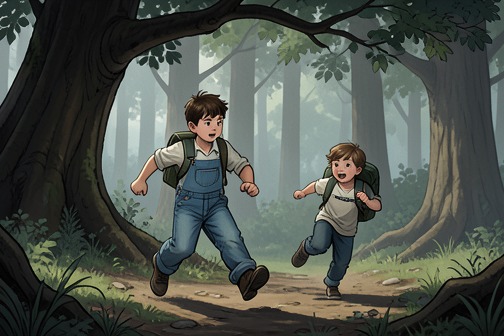
[Peter and Jamie’s disappearance](entity:event-recall-event-peter-and-jamie-s-disap-5c7eb98d9573) in [Knocknaree](entity:location-recall-location-knocknaree-d62cd5a36cda) is both an unresolved childhood case and the central absence in [Rob Ryan](entity:character-recall-character-rob-ryan-18e1297f6a56)’s own past. As an adult detective, Rob investigates a case that may connect to it while concealing that he was [Adam Ryan](entity:character-recall-character-adam-ryan-722038688481), one of the boys’ friends. His partial recovery of the day briefly brings the boys back into view, but neither the investigation nor his memories supply a complete account of what happened to them.
## The disappearance and Rob’s silence
Rob’s childhood memories of Knocknaree had largely vanished. After the original questioning, he recalls being unable to tell detectives anything: their voices seemed distant while his mind filled with images of clouds and grass. Investigators returned during school holidays and then at longer intervals, but eventually stopped. Their questions left him wary, and the blankness itself became frightening; he likened his mind to a test pattern replacing what should have been there.
As an adult, Rob kept his connection to the disappearance private, sharing it only with a few people. At boarding school he stopped using Adam and adopted his middle name, partly to avoid the publicity surrounding the missing children. He recognized that his new investigation might be connected to the old case, but did not tell O’Kelly. The rules against working a case involving personal emotional conflict meant disclosure could remove him from the investigation and expose him to renewed questioning. Rob also persuaded himself that reopening the matter served no practical purpose, while admitting that the secret appealed to his ego and his idea of himself as an enigmatic detective.
## Fragments recovered during the investigation
For the first time, Rob deliberately began probing the edges of his childhood memories. During sleepless early-morning walks through the city, he sometimes found himself far from where he thought he had been, with no recollection of how he got there. Memories then surfaced in brief, vivid fragments rather than as a continuous account: among them, Rob and [Peter](entity:character-recall-character-peter-22e18a2305ec) laughing at [Jamie](entity:character-recall-character-jamie-9ab1c29c9c6f)’s First Communion outfit, and other details of ordinary childhood life. Their intensity mattered to Rob because he had assumed that the first twelve years of his life were gone for good; it did not, however, make the fragments an explanation of the disappearance.
One night, after seeing a photograph that unsettled him, a memory struck Rob with enough force to wake him. He recalled approaching a clearing in [Knocknaree wood](entity:location-recall-location-knocknaree-wood-26139c5265ab) with Peter and Jamie on a hot day. The boys moved cautiously through the undergrowth because the sounds ahead were wrong. In the clearing, they saw men assaulting [Sandra Scully](entity:character-recall-character-sandra-scully-185d04c9c6be). This recovered scene establishes that Peter and Jamie were with Rob in the wood and places the boys near a violent event, but the evidence does not establish what happened to them afterward or explain the precise circumstances of their disappearance.
## Exposure and consequences
Rob’s concealment became a serious threat to the investigation once O’Kelly discovered it. O’Kelly pointed out that Rob was not merely a detective with a personal connection: he was the only eyewitness and surviving victim in a related unsolved case. Rob was stunned that he had never considered himself a possible suspect in Peter and Jamie’s disappearance. The revelation also made the omission consequential beyond his current assignment, since a defence lawyer could use his failure to disclose relevant information to challenge his other cases.
[Rosalind Devlin](entity:character-recall-character-rosalind-devlin-b7ac8dc19b99) later exposed Rob’s identity to [Cassie Maddox](entity:character-recall-character-cassie-maddox-309104c455a6), identifying him as Adam Ryan, the boy whose friends had disappeared in Knocknaree. Her disclosure made the private history between Rob and Cassie part of the investigation’s immediate conflict. The disappearance thus returns not only through memory but through the consequences of Rob’s silence: what he treated as a secret he could carry alone is revealed as information with implications for his colleagues, the case, and his credibility.
## The memory’s final retreat
After the investigation, Rob’s thoughts returned to Knocknaree during months spent alone in his apartment. He found that the memories he had worked to recover—Peter, Jamie, the wood, and the events surrounding Sandra Scully—had disappeared again. He could remember having remembered them, but now they seemed like distant scenes from old films or stories belonging to someone else. Rob feared that even these detached images would eventually fade altogether, and felt that their loss had something to do with having forfeited his claim to them.
One image remained: Rob and Peter sprawled on the grass in Peter’s front garden, trying to make a periscope from an old comic’s instructions. Without the cardboard tube they needed, they used rolled-up newspaper, which buckled and showed them only the sports page backwards. The small, imperfect childhood memory offers no solution to the disappearance. Its persistence instead leaves Rob with a remnant of friendship after the larger story of Peter and Jamie has once again withdrawn beyond his reach.
Event 20
Katy Devlin’s killing and the relocation of her body
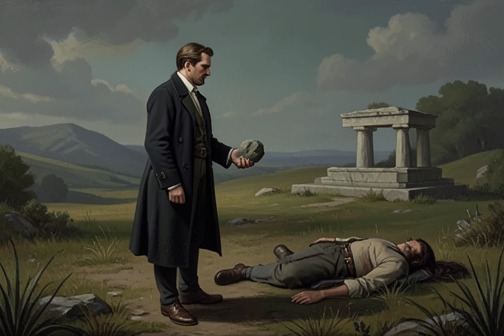
[Katy Devlin’s killing and the relocation of her body](entity:event-recall-event-713ac5f9f441) emerge through [Damien Donnelly](entity:character-recall-character-damien-donnelly-53edf227b71e)’s account during police questioning, rather than through a continuous, independently witnessed scene. His confession establishes that he struck [Katy](entity:character-recall-character-katy-670ee7b5b514) at [Knocknaree](entity:location-recall-location-knocknaree-d62cd5a36cda), caused her death, and moved her body before it was eventually placed on the altar stone. The account is also marked by omission: detectives later tell him that the evidence contradicts his version and confront him with an assault he had not disclosed.
## The confession and its conditions
The interview turns when [Cassie Maddox](entity:character-recall-character-cassie-maddox-309104c455a6) returns to the theory she had held from the start: the person responsible was not necessarily a habitual or willing killer, but someone who had acted under pressure and did not want to cause harm. [Rob Ryan](entity:character-recall-character-rob-ryan-18e1297f6a56) acknowledges that the rest of the team had doubted her, then reinforces her argument by describing the psychological collapse that can follow a killing and the fear of living under the threat of discovery. Cassie contrasts that concealed life with the possibility of confessing, serving a sentence, and eventually beginning again.
The detectives’ appeal is not neutral. They present remorse, sleepless fear, breakdown, and even suicide as possible consequences of keeping silent, while confession is framed as the path by which a culprit might survive. Damien is visibly tense; after being asked whether the description sounds familiar, he eventually nods. He then says that it just happened. The confession follows a sustained effort to make him identify himself with the reluctant perpetrator Cassie has described, so the scene records both an admission and the persuasive circumstances in which it was obtained.
Ryan arrests Damien on suspicion of murdering [Katharine Bridget Devlin](entity:character-recall-character-katharine-bridget-d-ec03767ff107) at Knocknaree in [County Dublin](entity:location-recall-location-county-dublin-83d4062095e1) on or around [17 August](entity:time-recall-time-17-august-e497040a5db8) of that year. The formal arrest follows the admission, but does not settle every question about the killing. Damien continues to shake, and the detectives take away the photographs and offer him tea, a sweater, or food. Ryan experiences the aftermath as unreal and connects the case to his own lost memories, his return to [Knocknaree wood](entity:location-recall-location-knocknaree-wood-26139c5265ab), the risk to his career, and the damage to his partnership. The confession is therefore a procedural breakthrough with immediate personal and professional costs for the investigator.
## The killing at the finds shed
In Damien’s later account, Katy arrived earlier than expected, at about a quarter to one rather than one o’clock. He says she knocked at the door of the finds shed carrying chocolate biscuits, gave him one, and spoke briefly about a ballet school. He describes directing her to look at a shelf and then striking her from behind with a rock. The detail of the biscuits and the short conversation places the attack within an ordinary meeting that Damien had been expecting, while the sudden violence marks the break between that anticipated encounter and what followed.
Damien says that when Katy struggled towards the door, he struck her again with the rock. He describes her becoming unconscious but still breathing, and says that he could not bring himself to strike her again. He then took a plastic bag used for finds and held it over her head until she stopped breathing. His description presents the fatal act as a continuation of an attempt to prevent her from leaving, while also emphasizing his claimed reluctance to inflict further harm. The account establishes the sequence he admitted to; it does not, by itself, resolve the wider question of motive.
## Concealment and the return to the site
After Katy’s death, Damien says he first planned to carry her out to the archaeological site. He left the bag in place because there was blood on her and he did not want it to spread. That plan changed when he saw a light in the wood, like a campfire, and feared that someone might see him. He returned to the sheds rather than continue across the site with her body.
In the tools shed, Damien wrapped Katy in a tarp used to cover parts of the excavation when rain threatened and put her beneath the other tarps. He says he was worried that animals might reach her if he left her in a field, and that he hoped he would know what to do by the following night. The account conveys a makeshift effort to conceal her while also giving his stated reason for keeping her sheltered. It does not turn that explanation into proof of his intentions: it remains Damien’s account, offered during questioning.
Damien later says he put gloves on again, removed Katy from the shed, and carried her to the site. He placed her on the altar stone, describing it as a place where she would be safe from animals and found sooner. He says he tried to make her appear to be sleeping, discarded the rock, rinsed the plastic bag, and returned it to its place. He could not find her torch, which he said was somewhere behind the tarps. When Ryan asks why he did not bury her, Damien answers that he had not thought of it; he says he wanted to leave quickly and did not think of burying her as a way to dispose of her. In his account, the altar stone becomes the final destination not through a settled plan, but after fear interrupts his first attempt to move her and he chooses a location where she might be found.
## What the account leaves unresolved
The confession is not complete. Damien has described the killing and the movement of Katy’s body but has skipped the trowel. When Ryan later challenges him, he cites the post-mortem and the trowel found that morning in the tools shed, then tells Damien that the evidence indicates a further assault with its handle. Damien denies the accusation before breaking down. The confrontation shows that the initial admission did not include all the acts the detectives believed the physical evidence established.
That gap matters to how the episode should be understood. The interview first draws out a broad admission through an appeal to fear, remorse, and the possibility of eventual release; later, it becomes a direct evidentiary challenge focused on what Damien has withheld. The novel thus distinguishes confession from full disclosure. Damien’s account supplies a detailed route from the finds shed to the tarps and back to the altar stone, but the omission and the detectives’ subsequent confrontation prevent his narrative from serving as an unqualified explanation of the crime.
Event 21
Damien Donnelly’s confession and arrest
[Damien Donnelly’s confession and arrest](entity:event-recall-event-a78fbff447d7) turn [Cassie Maddox](entity:character-recall-character-cassie-maddox-309104c455a6)’s long-standing profile of [Katy Devlin](entity:character-recall-character-katy-devlin-0f044f95eda4)’s killer into a pivotal interrogation strategy. Damien first acknowledges that killing [Katy](entity:character-recall-character-katy-670ee7b5b514) happened without his wanting it, then describes striking her with a rock; [Rob Ryan](entity:character-recall-character-rob-ryan-18e1297f6a56) formally arrests him on suspicion of murder. The scene presents confession as both a breakthrough and an incomplete account: later questioning reveals that Damien has withheld important details, complicating any easy equation between admission and full disclosure.
## Background and Interview Strategy
Cassie has argued from the beginning that the killer was not a habitual violent offender who enjoyed causing pain, but someone who did not want to kill and believed he had no choice. Rob acknowledges that the other investigators had dismissed this interpretation, yet he and Cassie now use it to address Damien directly. Their approach gives him a possible identity other than that of a person defined by cruelty: a man who committed a terrible act and might be able to admit it.
The appeal is also calculated. Rob describes what can happen to people who commit violence and conceal it: fear, recurring distress, psychological collapse, or suicide. Cassie contrasts that life with the possibility of confessing, serving a prison sentence, and eventually living without constant fear of discovery. The investigators present confession as a route through consequences, not as a way to avoid them. Their argument is emotionally forceful, however, and the scene makes that pressure part of the circumstances in which Damien speaks.
## The Admission
Asked quietly whether the description sounds familiar, Damien finally gives a small nod. He indicates that he does not want to live with the fear being described. Cassie touches his arm briefly, then withdraws her hand; the narration emphasizes that the gesture is restrained and not something that could be presented as coercion. She asks whether he wanted to kill Katy or whether it simply happened. Damien answers that it just happened.
The response marks the interview’s decisive turn. Until then, the detectives have been building a hypothetical account around Cassie’s profile; Damien’s answer connects that account to himself. His grip on a can has tightened until it buckles, and after his admission his hands go limp and the can falls onto the table. The narration registers the pause as a collective shock. Rob then identifies Damien by his full name and states the arrest: he is being arrested on suspicion that, on or around [17 August](entity:time-recall-time-17-august-e497040a5db8) of that year, at [Knocknaree](entity:location-recall-location-knocknaree-d62cd5a36cda) in [County Dublin](entity:location-recall-location-county-dublin-83d4062095e1), he murdered [Katharine Bridget Devlin](entity:character-recall-character-katharine-bridget-d-ec03767ff107), contrary to common law.
## Damien’s Account and Its Omissions
The confession develops beyond the initial admission. Damien recalls that Katy arrived earlier than expected, at approximately a quarter to one, carrying chocolate biscuits. She gave him one, which he put in his pocket without eating; she ate hers and spoke for a few minutes about ballet school. Damien says that he directed her to look at a shelf, then struck the back of her head with a rock. His account supplies a sequence of actions and a specific object, while his evident disbelief as he recounts the blow underscores the difference between describing what happened and seeming able to accept that he did it.
That account does not resolve every question. In later questioning, Rob challenges Damien for leaving out evidence concerning the archaeological trowel found in the tools shed. Rob points to the post-mortem photographs and findings, then confronts Damien with the further assault indicated by the evidence. Damien denies or resists the accusation, becomes distressed, and does not provide the motive Rob is seeking. The investigators therefore have a confession to killing Katy, but not a complete or uncontested account of the crime’s circumstances. The distinction matters: Damien’s first admission is a major investigative breakthrough, not a final explanation of everything that happened.
## Arrest and Narrative Consequences
After the arrest, Damien continues to shake and refuses the practical comforts offered by the detectives, including fresh tea, an extra sweater, and reheated pizza. Rob remains fixed on him, reflecting on the personal and professional cost of the investigation: he has searched his own mind for memories, returned to [Knocknaree wood](entity:location-recall-location-knocknaree-wood-26139c5265ab), risked his career, and is losing his partner. The confession thus closes one immediate investigative question while leaving Rob’s private damage unresolved.
The scene also gives Cassie’s profile a qualified vindication. Her account of a reluctant killer helps open the way to Damien’s admission, but it does not establish that every part of his conduct was involuntary or explain the details he concealed. The later confrontation over the trowel resists a simple redemption narrative: remorse, fear, and a statement that the killing just happened coexist with evidence of further violence and continued evasion. Arrest makes the confession consequential in law and in the investigation, but the narrative preserves the gap between admitting responsibility and telling the whole truth.
Event 22
Rosalind’s prolonged poisoning of Katy
[Rosalind’s prolonged poisoning of Katy](entity:event-recall-event-8ebc3c874de3) was a concealed pattern of abuse that turned illness into a means of controlling her younger sister’s dancing and visibility. Its significance lies not only in [Rosalind](entity:character-recall-character-rosalind-239002ff9e41)’s later admission but in the contrast between that admission and [Katy](entity:character-recall-character-katy-670ee7b5b514)’s private record: Katy had begun to suspect the supposed remedy was making her sick, even as her diary’s final entry presents Rosalind as apologetic and affectionate.
## Background and Motive
[Cassie Maddox](entity:character-recall-character-cassie-maddox-309104c455a6) reconstructs the poisoning as a practice that began years before [Damien Donnelly](entity:character-recall-character-damien-donnelly-53edf227b71e) knew Katy. In her account, the first illness came when Katy was about to leave for ballet school and became so unwell that she had to give up her place. Cassie connects the pattern to Katy’s talent and the attention it brought her: Rosalind, she argues, could not bear the admiration focused on her younger sister. This motive is Cassie’s interpretation of the evidence, not an explanation established by [Katy’s diary](entity:object-recall-object-katy-s-diary-3a274ab47d0c) alone.
The sisters’ changing ages and circumstances matter to Cassie’s reconstruction. She suggests that when Katy was younger, she would have trusted an older sister who described a substance as secret medicine. Years later, Katy had a second chance at ballet school and was old enough to question what she was being given. Cassie places Katy’s growing public profile alongside that change: a newspaper article, a fundraiser, and the attention she received in [Knocknaree](entity:location-recall-location-knocknaree-d62cd5a36cda) made her increasingly prominent. In Cassie’s reading, Katy’s refusal to comply marked a decisive break in Rosalind’s control.
## Method and Admission
Rosalind later described the poisoning to Cassie Maddox as a way of stopping Katy from dancing, at times, and of cutting down the attention she received. She framed her actions against what she called her parents’ failure to correct Katy, while presenting her own intervention as necessary. The claim does not excuse the poisoning; rather, it reveals how Rosalind recast deliberate harm as a response to her sister’s perceived self-importance.
Rosalind admitted mixing juice with detergent, cleaning products, or other substances of her choosing, then telling Katy that the mixture was a secret recipe to improve her dancing. Cassie had earlier listed possible household substances, including bleach, emetics, and salt, as examples of how someone might cause an unexplained gastric illness. Those were possibilities in Cassie’s theory; Rosalind’s later account specifically names detergent and cleaning products, without establishing that every substance Cassie mentioned was used.
Rosalind also said she had wondered whether anyone would discover what she was doing, but that nobody did. The admission gives the earlier illnesses a concealed cause and shows that Katy’s suffering was not an accidental consequence of a treatment intended to help her. Rosalind’s deception joined the substance to its cover story: what was presented as assistance with dancing was, in fact, a means of making dancing difficult or impossible.
## Katy’s Diary and Resistance
Katy’s diary supplies a private record of the conflict that Rosalind’s account presents from the other side. In one entry, Katy notes that [Simone Cameron](entity:character-recall-character-simone-cameron-2b308e830cc2) had said she could not keep getting sick. Katy writes that she refused to drink what Rosalind gave her, that Rosalind warned she would not become a good dancer without it, and that Rosalind became angry. Katy records her own suspicion that the mixture was making her sick. The entry documents a moment when she no longer accepted her sister’s explanation, even though she was frightened by the anger and by the pressure surrounding her dancing.
The diary also places the poisoning within a broader pattern of pressure. Katy records being told that [Jessica Devlin](entity:character-recall-character-jessica-devlin-ea876c49a0f5) might kill herself if Katy left for ballet school, with Katy made to feel responsible. She describes friendships strained after Rosalind told another girl that Katy thought she would not be good enough once Katy went away. These entries do not prove that each episode had the same purpose as the poisoning, but they show the emotional environment in which Katy’s choices about ballet were being constrained.
Katy found the diary in Rosalind’s shoebox in her wardrobe after it disappeared from beneath her bed. Afraid that Rosalind would be angry, she nevertheless took it and kept it at Simone’s home, where she could write privately after practicing alone. The detail makes the diary more than a retrospective account: Katy had reason to hide her writing and had already identified Rosalind as someone whose response she feared.
## The Final Entry and Narrative Significance
The diary’s last entry was written three days before Katy died. Katy records that Rosalind was sorry for having been harsh about her going away and attributes that behaviour to concern for Jessica and sadness about Katy’s departure. Rosalind was also going to get her a lucky charm for dancing. The entry preserves Katy’s hope that the relationship had softened; it does not establish that the apology was sincere or that the promised charm was given. Set beside Rosalind’s admission, its apparent reconciliation sharpens the contrast between Katy’s trust and the prolonged deception she had endured.
The poisoning becomes legible only through evidence that arrives in different forms: Cassie Maddox’s reconstruction, Rosalind’s admission, and Katy’s diary. Their combination distinguishes suspected motive from admitted method and shows how a secret explanation for repeated illness remained hidden even as Katy began to resist it. The diary also restores Katy’s own perspective to a case in which her experience had largely been interpreted by others. Her refusal to drink the mixture is a small but consequential act of recognition; its record survives beside the final entry’s renewed hope, leaving the reader with both her resistance and the limits of what she understood before her death.
Event 23
Rosalind’s confession to involvement in the murder and arrest
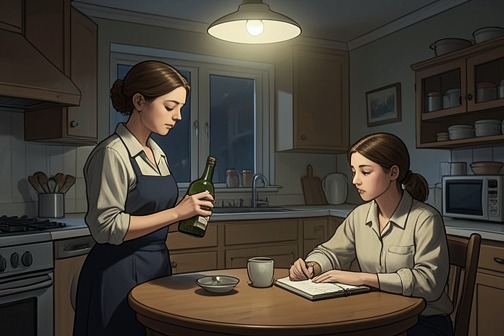
[Rosalind’s confession to involvement in the murder and arrest](entity:event-recall-event-58480be1f35c) exposes both the deliberate cruelty behind [Katy](entity:character-recall-character-katy-670ee7b5b514)’s illness and the limits of what the detectives can use in court. In a conversation arranged by [Cassie Maddox](entity:character-recall-character-cassie-maddox-309104c455a6), [Rosalind](entity:character-recall-character-rosalind-239002ff9e41) acknowledges poisoning her sister and explains the plan she expected [Damien Donnelly](entity:character-recall-character-damien-donnelly-53edf227b71e) to carry out, while insisting that she never directly ordered him to act. Her arrest follows, but a procedural mistake over her age and the presence of an appropriate adult strips the confession of evidentiary value and leaves the murder case precarious.
## The suspicion behind the confession
The investigation had already established that Katy left her home during the night or early morning, dressed for outdoors and carrying her house key. Her clothes and preparations suggested that she expected to return; the detectives found no reason to think an intruder had taken her from her bed. When they searched her shared bedroom, they found a sharp contrast between the sisters’ spaces: Jessica’s wall held idyllic prints, while Katy’s was devoted to ballet, including her acceptance letter from the [Royal Ballet School](entity:location-recall-location-royal-ballet-school-6e4473391811). The room made Katy’s ambitions visible, and those ambitions would become central to Rosalind’s explanation of why she targeted her.
Before the interview, Damien had described Rosalind as a sister protecting Jessica from abuse at home. He said Rosalind would not leave because she feared abandoning Jessica, and that she had trusted him with the story. But [Rob Ryan](entity:character-recall-character-rob-ryan-18e1297f6a56) recognized that Damien believed his account without treating it as verified fact. Medical records and the post-mortem contradicted some of the specific claims he repeated: Jessica’s arm had been broken in a witnessed accident, Rosalind had not suffered the injury Damien described, and Katy had died a virgin. The distinction matters to the confession scene: Damien’s devotion had helped him build a private story about Rosalind, but his account could not establish that story as true.
Katy’s own diary supplied a different record of the sisters’ relationship. It described Rosalind pressuring her to give up dancing and tying Jessica’s wellbeing to Katy’s decision to pursue ballet school. In another entry, Katy wrote that Rosalind insisted she drink something despite her suspicion that it made her sick. These details gave the investigators grounds to question the illness that had interrupted Katy’s dancing, even as the family’s earlier explanations had left the cause unresolved.
## Cassie confronts Rosalind
Cassie tells Rosalind that the detectives have arrested Damien for [Katy’s murder](entity:event-recall-event-katy-s-murder-268f0534d2f7) and that he says he acted for her, at her request. Rosalind initially notes that Damien talks readily, but Cassie presses the connection between his account and the crime. As the conversation proceeds, Rosalind gives a motive in her own words, framing Katy’s success in ballet as attention she did not deserve and presenting interference with her dancing as a way to put her in her place.
Rosalind then admits that she made Katy ill. She says she mixed detergent or other cleaning products into juice and represented it as a recipe that would improve Katy’s dancing. The account turns the diary’s suspicion into a direct admission: Katy had not simply been suffering an unexplained illness, and the drinks she was persuaded to take were part of Rosalind’s deliberate effort to disrupt her dancing. Rosalind also says that she wanted to see whether anyone would discover what she was doing; no one had.
Her account of Damien’s role is more qualified. Rosalind denies telling him to do anything to Katy and claims that he devised the ideas himself. Yet she describes the outcome she had wanted: an attack, a killing with a rock, and the abandonment of Katy’s body at the archaeological dig or in the wood. She says Damien failed to carry out the plan as intended, hid the body, and risked exposing them. Her contempt for his mistakes sits uneasily beside the fact that she acknowledges wanting Katy dead and describes a plan designed to achieve it. Cassie recognizes that the exchange has supplied the admission the investigators needed and arrests Rosalind on suspicion of murdering Katy in [Knocknaree](entity:location-recall-location-knocknaree-d62cd5a36cda), [County Dublin](entity:location-recall-location-county-dublin-83d4062095e1).
## Arrest and the evidentiary reversal
The arrest does not settle the case. Rosalind resists Cassie physically, and the police also arrest her for assaulting an officer. At the station, she asks for her parents and invokes the rule that a minor is entitled to have a parent or guardian present during an interview. The detectives stop the questioning. Checking the file, [Sam](entity:character-recall-character-sam-d93f992a0ed0) O’Neill realizes that Rosalind’s birthday is 2 November and that she is not yet eighteen. Rob had previously checked the family file while arranging Jessica’s interview, but he had wrongly treated Rosalind as an appropriate adult.
Cassie immediately understands the consequence: Rosalind’s interview cannot be used, including the confession that had seemed to provide the decisive breakthrough. The error does not erase what the detectives heard, but it leaves them unable to rely on those statements as admissible evidence. Rosalind has also claimed that Cassie struck her first, giving the assault allegation its own contested account. The arrest therefore produces a sharp reversal: the investigators have heard Rosalind explain her conduct, yet the procedural safeguards they failed to observe prevent that explanation from doing its intended work in court.
## What remains of the case
After Rosalind’s parents arrive, she says little beyond alleging that Cassie assaulted her. The police prepare a file for the prosecutor’s office on both the murder and officer-assault charges, but the detectives judge the murder evidence weak. Without the inadmissible interview, they have Damien’s account and mobile-phone records; the earlier lead involving the Tracksuit Shadow is no longer available to link Rosalind as an accessory. Nor can the investigators establish that Jessica’s earlier interview was properly supervised, since Rosalind was not an appropriate adult and Rob cannot prove that the required supervision took place.
The investigation room is then cleared: photographs, family snapshots, and suspect images are taken down and filed away, while the map of Knocknaree begins to curl and tear. That practical dismantling follows the legal defeat of the confession. The event reveals Rosalind’s deliberate poisoning of Katy and her desired role in the killing, but it ends without converting that knowledge into a secure prosecution. Its central irony is not that the truth remains wholly hidden, but that a confession heard by the detectives cannot carry the evidentiary weight they need.
Event 24
Damien Donnelly’s murder trial and conviction
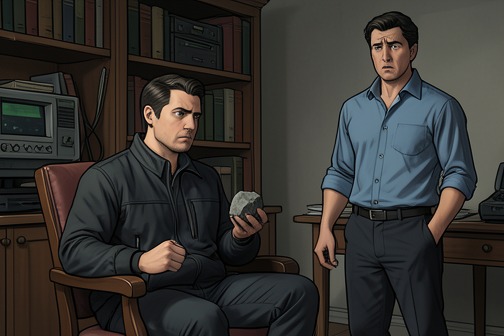
[Damien Donnelly’s murder trial and conviction](entity:event-recall-event-8cc90804a0c1) turn the investigation’s contested explanations into a verdict: the jury finds him guilty of murder and he is sentenced to life imprisonment. The courtroom record includes his confession, opposing claims about his mental state and motives, and [Cassie Maddox](entity:character-recall-character-cassie-maddox-309104c455a6)’s account of his apparent submission to [Rosalind Devlin](entity:character-recall-character-rosalind-devlin-b7ac8dc19b99)’s influence. [Rob Ryan](entity:character-recall-character-rob-ryan-18e1297f6a56) does not testify, leaving him to watch the case’s public conclusion from the back of the courtroom and afterward from a pub television. The outcome settles Damien’s criminal responsibility, but it does not dissolve the distortions and private histories that shaped the crime.
## Background and the Limits of the Record
The trial follows [Damien Donnelly](entity:character-recall-character-damien-donnelly-53edf227b71e)’s confession, but the prosecution and defense contest how his actions should be understood. The case involves complex disputes over the admissibility of evidence and extended psychiatric debate about his mental state. Ryan hears much of this legal argument indirectly, through fragments of conversation and repeated telephone calls from Quigley, rather than from inside the courtroom. The contrast matters: the verdict is firm, while the route by which the case is presented remains complicated and, for Ryan, partly out of view.
The defense advances two related arguments. It claims that Damien Donnelly was temporarily insane; alternatively, it argues that he believed he was protecting Rosalind Devlin from serious harm. The latter claim makes the private story Damien accepted central to the legal account: he presents the murder as necessary within a world in which [Rosalind](entity:character-recall-character-rosalind-239002ff9e41) and [Jessica Devlin](entity:character-recall-character-jessica-devlin-ea876c49a0f5) needed his protection. The prosecution, by contrast, has a full confession and autopsy photographs of [Katy Devlin](entity:character-recall-character-katy-devlin-0f044f95eda4). Ryan regards the evidence as so powerful that the jury could scarcely have reached another verdict, even amid the legal and psychiatric disputes.
## Ryan’s Absence and Maddox’s Testimony
Ryan is advised not to testify because the prosecutor fears that Rosalind may have told Damien about Ryan’s personal history, creating a risk that it could become relevant in court. Ryan doubts Rosalind would have given Damien anything useful, and believes Cassie Maddox had persuaded her to abandon that line of attack, but he does not challenge the prosecutor’s decision. His silence is thus a deliberate precaution, not a sign that he has no connection to the case. He remains outside the formal account at a moment when his own vulnerabilities might be used against him.
Instead, Ryan attends Cassie Maddox’s testimony. The courtroom is unusually full, and the trial has already attracted extensive attention in newspapers and on talk radio. Several months have passed since Ryan last saw her. From the back of the room, he notices that she seems more subdued than he remembers, while her controlled presence on the stand reflects the courtroom skill he has long associated with her. She answers questions in a quiet, clear voice and holds the jury’s attention.
On cross-examination, Cassie Maddox concedes points that help Damien Donnelly’s defense: he had seemed agitated and confused, and appeared genuinely to believe that the murder was necessary to protect [Rosalind Devlin and Jessica Devlin](entity:relation-recall-relation-rosalind-devlin-and-6bdf5a887c7b). She also gives her professional opinion that Rosalind had influenced him and urged him to commit the crime. Her testimony does not erase his responsibility; it places his conduct within the influence she believes Rosalind exerted. Damien watches her with a dazed, uncomprehending expression. When the defense asks whether he had explained his motive at the time of his confession, Cassie says that he had not: he either declined to answer or said he was unsure.
The courtroom account also contains a stark reversal of trust. Damien Donnelly had tried to take his own life after learning that Rosalind Devlin planned to testify against him. His reaction underscores how completely he had invested in the belief that he was protecting her and Jessica. At trial, that belief becomes both a defense argument and evidence of the influence Cassie describes, while Rosalind’s willingness to testify against him signals the collapse of the relationship on which his explanation depended.
## Verdict, Sentence, and Public Response
The jury finds Damien Donnelly guilty. The sentence is life imprisonment, which Ryan explains will in practice usually mean roughly ten to fifteen years. The verdict follows a defense built around both temporary insanity and a claimed effort to protect Rosalind, but neither argument overcomes the confession and the prosecution’s evidence concerning Katy Devlin’s death.
The sentence carries an additional consequence inside the prison system. Because of the sexual assault on Katy Devlin, Damien Donnelly is classified as a sex offender and placed in a high-risk unit with prisoners who would be vulnerable in the general population. Ryan sees an irony in the fact that the trowel may have helped save Damien’s life: he gives no further account of its role in that protection, but connects it to Damien’s eventual prison circumstances. The placement is no simple reprieve; it is a different form of danger, though Ryan believes it improves Damien’s chances of surviving custody.
Outside the courthouse, a small crowd waits for Damien after sentencing. Ryan watches news footage from a dingy pub near the quays as uniformed officers escort him through the crowd and into a van amid shouts and blows against it. One onlooker calls for the death penalty. The public anger supplies a rough, immediate counterpoint to the court’s formal judgment: the sentence is delivered through legal procedure, while the crowd demands a more openly punitive response. Ryan knows he ought to feel compassion for Damien, whose path to the crime began with his involvement in Rosalind’s story, but finds that he cannot summon it.
## What the Verdict Resolves—and What It Does Not
The conviction establishes Damien Donnelly’s legal guilt, not the truth of every story that gathered around the murder. Earlier in the investigation, Jessica Devlin had said that a man had frightened Katy Devlin, but her speech and testimony were difficult to obtain without adults speaking for her. At another interview, Rosalind began to explain what Jessica had seen before Ryan insisted that the account had to come directly from Jessica to avoid hearsay. These scenes expose how easily a child’s account could be mediated, even as the trial later has to assess what Damien himself believed about Rosalind and Jessica.
Katy Devlin’s diary, read by Ryan after the sentencing, further complicates the distance between a legal conclusion and a victim’s private experience. Its entries record [Katy](entity:character-recall-character-katy-670ee7b5b514)’s fear that Rosalind was making her ill and her refusal to take what Rosalind insisted she drink. That material appears in Ryan’s later reading of the case, not as evidence the trial is said to have presented. Its placement after the verdict gives the reader another account of the family’s coercive dynamics, one that does not depend on Damien’s belief or Rosalind’s testimony. The trial closes the murder case with a conviction; the surrounding narrative continues to reveal how partial and vulnerable any single account of the events can be.
Event 25
Disappearance of Peter and Jamie
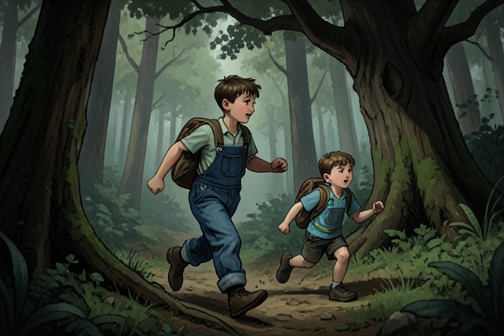
[The disappearance of Peter Savage and Jamie Rowan](entity:event-recall-event-the-disappearance-of-pe-a35418b5c282) returns to [Rob Ryan](entity:character-recall-character-rob-ryan-18e1297f6a56) not as a fully reconstructed account of the day they vanished, but as a bodily memory of the [Knocknaree](entity:location-recall-location-knocknaree-d62cd5a36cda) Wood they shared. Recalled decades later amid the destruction of the trees, the boys’ absence is set against Rob’s recognition that the place had once been their playground and refuge—and that he had been there with them.
## The remembered wood
As Rob reaches the site, the machinery and chainsaws are reducing the wood to exposed roots and splintered trunks. The sight brings back a childhood image: Rob scrambling up a castle wall, crisp packets crackling in his T-shirt, while [Peter](entity:character-recall-character-peter-22e18a2305ec)’s running shoe searches for a foothold above him and [Jamie](entity:character-recall-character-jamie-9ab1c29c9c6f)’s blond hair rises among the swaying leaves. The memory gives the disappearance a setting shaped by ordinary play rather than by the ominous landscape Rob had come to associate with the case.
The recollection also changes the meaning of the wood for Rob. He had thought of it as an invincible, stalking presence, a shadow over the secrets in his mind; now he remembers it as an easy playground and a much-loved refuge. Seeing it cut down makes its former beauty newly visible to him. The threatened place is therefore bound not only to what happened to Peter and Jamie, but also to a childhood Rob had partly lost access to.
## Rob’s place in the disappearance
The memory places Rob alongside the two missing boys. He recalls climbing with them and describes Peter and Jamie as familiar presences in the scene, not figures learned about later from records. The passage does not reconstruct the precise circumstances of their disappearance; instead, it establishes the intimate fact of Rob’s connection to them and leaves the central absence intact.
That connection becomes explicit when Rob tells a workman that two of his friends went missing there in the 1980s. The man remembers the case as involving two young children and asks whether Rob was the little boy who had been with them. Rob confirms that he was. The exchange links Rob’s private recollection to the public memory of the disappearance: to the workman, the event is an old local tragedy; to Rob, it remains a personal past that the transformed site has abruptly brought back.
## A past exposed by destruction
The scene presents the disappearance through a late return of memory. Rob is not at the wood to witness the boys vanish; he is there years later, when construction has made the landscape almost unrecognizable. The demolition prompts a recollection of climbing, leaves, stone, and companionship, while the workman’s recognition confirms that Rob’s presence belongs to the remembered history of the case.
The contrast between the boys’ lively childhood refuge and the ruined excavation gives the recollection its force. As the physical place is erased, details of the shared outing surface with unusual clarity, even though the disappearance itself remains unexplained in this passage. Rob’s memory thus preserves both what he can recover—the boys together in the wood—and the gap around what happened to them.
Event 26
Katy’s murder
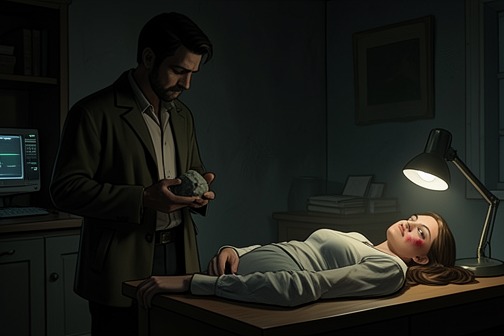
[Katy’s murder](entity:event-recall-event-katy-s-murder-268f0534d2f7) emerges not as a complete, settled account but as a confession assembled under pressure and revisited through evidence found too late to change the case. [Damien Donnelly](entity:character-recall-character-damien-donnelly-53edf227b71e) admits striking [Katy Devlin](entity:character-recall-character-katy-devlin-0f044f95eda4) with a rock, while the subsequent questioning reveals that his first account left out crucial information. A diary entry written by [Katy](entity:character-recall-character-katy-670ee7b5b514) before her death then restores a small part of her life beyond the crime, without providing proof sufficient to establish another person’s involvement.
## The confession
During questioning, [Cassie Maddox](entity:character-recall-character-cassie-maddox-309104c455a6) uses her profile of the killer to argue that the person responsible was not necessarily violent by nature, but may have acted because he believed he had no choice. [Rob Ryan](entity:character-recall-character-rob-ryan-18e1297f6a56) backs her account, then presses Damien with the prospect of what might follow if the killer continued to conceal the truth: fear, psychological collapse, or suicide. Cassie counters that confessing and serving a sentence could allow the offender eventually to live without the constant fear of discovery. The appeal makes the interview’s strategy explicit: the detectives present confession not only as an admission of responsibility, but as a way out of a life organized around concealment.
Damien is visibly tense throughout the exchange. He crushes an empty can in his hand before, after a long pause, giving a small nod in response to Rob’s question about whether the detectives’ description feels familiar. That reaction leads into his account of Katy’s visit. He says he had expected her at one o’clock, but she arrived around a quarter to one. She brought chocolate biscuits, gave him one, and spoke briefly about a ballet school. Damien says he directed her to look at a shelf, then struck her on the back of the head with a rock. The admission supplies the central act of the murder, but the account is fragmentary and does not answer every question the detectives raise.
## What the first account leaves out
Later, Rob confronts Damien with the post-mortem findings and the discovery of a trowel in the tools shed. He accuses Damien of failing to disclose that the tool had been used to sexually abuse Katy after he killed her. Damien denies or resists the accusation, and Rob insists that such conduct could not simply have happened without a reason. The exchange does not produce an explanation: Damien begins to cry, and the interviewers spend a long time waiting and trying, without success, to draw out a motive.
The contrast between Damien’s initial admission and the later confrontation matters to how the confession can be read. The detectives have evidence they believe contradicts his omissions, but their questions are also forceful and, at points, supply details and interpretations for him to answer. His distress and his earlier nod are not a substitute for a complete account. The scene establishes that he struck Katy and that investigators regarded his first version as incomplete; it leaves the motive and the full extent of what happened without a clear answer in this interview.
## [Katy’s diary](entity:object-recall-object-katy-s-diary-3a274ab47d0c) and the limits of later evidence
A year after Katy’s death, Rob reads entries from her diary. One describes her discovering that the diary had been moved from beneath her bed to a shoebox in [Rosalind Devlin](entity:character-recall-character-rosalind-devlin-b7ac8dc19b99)’s wardrobe. Afraid [Rosalind](entity:character-recall-character-rosalind-239002ff9e41) would be angry if she took it back, Katy instead decides to keep it at [Simone Cameron](entity:character-recall-character-simone-cameron-2b308e830cc2)’s home, where she can write while practicing alone. The passage records a private act of caution and a decision to preserve a space of her own.
The final entry is dated three days before Katy died. Katy writes that Rosalind has apologized for being hostile about her going away, explaining that she had been worried about [Jessica Devlin](entity:character-recall-character-jessica-devlin-ea876c49a0f5) and would miss Katy too. Rosalind plans to give her a lucky charm for her dancing. Another diary passage mentions Rosalind making Katy drink something, but Rob recognizes that the detail could have been explained as an ordinary drink and that the charm proves nothing. The diary deepens the reader’s view of Katy’s relationships and final days; it does not, by itself, directly connect Rosalind to a crime.
## Aftermath and narrative significance
Rob sends the diary and a small paper pouch to [Sam](entity:character-recall-character-sam-d93f992a0ed0) O’Neill at [Dublin Castle](entity:location-recall-location-dublin-castle-3a867487cf8b), where they are stored with the case materials. The investigation is closed, and Rob sees no basis for reopening it unless Rosalind commits a similar crime. Simone asks whether finding the diary earlier would have made a difference. Rob says probably not, while admitting to himself that he does not know whether that is true. The possibility that earlier discovery might have mattered remains unanswered.
The diary’s late arrival shifts attention from the investigative image of Katy as a victim to the ordinary, specific person who wrote about dancing, practice, a missing notebook, and a hoped-for lucky charm. Yet that recovery is incomplete: Rob reflects that the case had occupied more of his attention than Katy herself, and that the murder had eclipsed the rest of her life. The event’s aftermath therefore turns on two limits at once: Damien’s account does not resolve every aspect of the crime, and the surviving evidence cannot restore the future Katy expected or settle every suspicion around her death.
Event 27
Rosalind’s trial
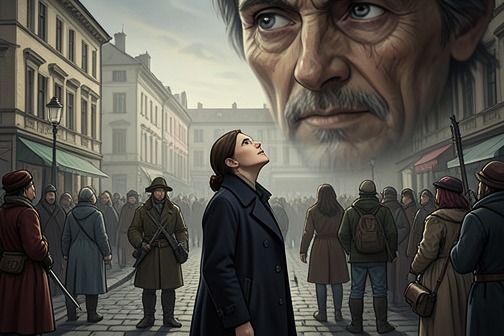
[Rosalind’s trial](entity:event-recall-event-rosalind-s-trial-316410fce0ee) is a turning point whose proceedings are not narrated in detail: the account looks back after the trial has ended, then reveals a diary that might have complicated the case but could not directly implicate [Rosalind Devlin](entity:character-recall-character-rosalind-devlin-b7ac8dc19b99). The surrounding evidence connects [Damien Donnelly](entity:character-recall-character-damien-donnelly-53edf227b71e)’s confession to the investigation and establishes the limits of what investigators could do with the diary after the case was closed.
## The confession and the case against Damien
Before the trial, Detective [Cassie Maddox](entity:character-recall-character-cassie-maddox-309104c455a6) had argued from the outset that [Katy](entity:character-recall-character-katy-670ee7b5b514)’s killer was someone who had acted unwillingly, rather than a habitual or predatory offender. [Rob Ryan](entity:character-recall-character-rob-ryan-18e1297f6a56) recalls that the other detectives had dismissed her theory, but her insistence on it shaped the questioning of Damien. Ryan and Cassie presented confession as a way to end a life of fear and guilt; Damien eventually gave a small nod when Ryan asked whether their account sounded familiar.
In his account, Damien said he had expected Katy at one o’clock, but she arrived around a quarter to one. She brought chocolate biscuits, spoke briefly about a ballet school, and ate one while he could not bring himself to eat. He then directed her to look at a shelf and struck her from behind with a rock. The details establish his admission and the circumstances he described, but the novel does not provide the trial testimony or show how this account was presented in court.
Damien’s confession did not initially supply a complete explanation of what he had done. When Ryan confronted him with the post-mortem findings and the trowel discovered in the tool shed, Damien denied that he was withholding anything, then broke down crying. Ryan pressed him to explain the omitted assault, but Damien did not answer. The episode therefore distinguishes the confession from a full account: Damien admitted killing Katy, yet the motive and parts of his conduct remained unresolved in the interview.
## [Katy’s diary](entity:object-recall-object-katy-s-diary-3a274ab47d0c) after the trial
A later scene takes place after the trial has ended and Katy has been dead for a year. Simone finds Katy’s diary, which Katy had searched for after discovering it missing from beneath her bed. She had found it in a shoebox in [Rosalind](entity:character-recall-character-rosalind-239002ff9e41)’s wardrobe, feared Rosalind would be angry if she took it, and moved it to Simone’s so she could write privately while practicing.
The final diary entry was written three days before Katy died. Katy recorded that Rosalind had apologized for opposing her plan to go away, explaining that she had been worried about Jessica and upset at the prospect of Katy being far from home. Katy also wrote that Rosalind intended to make amends by getting her a lucky charm for dancing. The entry preserves Katy’s own hopeful account of the relationship, in sharp contrast with the murder investigation’s focus on her death.
Rob considers whether the diary would have changed anything if it had been found earlier. He doubts it would have established a crime: the mention of Rosalind making Katy drink something could have been explained as a vitamin drink or Lucozade, and the promised lucky charm proved nothing. Simone raises the possibility that finding it before Katy died might have mattered, but Rob has no answer. The diary supplies intimate evidence of Katy’s expectations, not direct proof against Rosalind.
## Closure and the limits of the record
Rob places the diary and its small paper pouch in an evidence bag and sends them to [Sam](entity:character-recall-character-sam-d93f992a0ed0) at [Dublin Castle](entity:location-recall-location-dublin-castle-3a867487cf8b). He expects them to be stored in the basement with other case material. The case is closed, and he sees no investigative use for the objects unless Rosalind does the same thing to someone else. His reflection makes the timing consequential: the diary becomes available only after the trial, when it can no longer change the investigation described in the account.
The narrative confirms that the trial has ended and the case is closed, but does not recount the trial itself or specify its verdict or sentence. Instead, it sets the detectives’ earlier efforts to obtain Damien’s confession beside the diary’s belated, inconclusive testimony. The result is a narrow but significant aftermath: Katy’s private words restore some of her life beyond the case, while also showing how little they can establish about Rosalind’s criminal responsibility.
Event 28
Knocknaree motorway construction and protests

[Knocknaree motorway construction and protests](entity:event-recall-event-knocknaree-motorway-con-1251ba049dfa) mark the defeat of efforts to preserve the site and the near-destruction of the wood beside it. The road goes ahead along its original route despite injunctions, constitutional challenges and a protest camp; when [Rob Ryan](entity:character-recall-character-rob-ryan-18e1297f6a56) visits during construction, the scene forces him to remember the place not only as a shadow over his past but as a landscape he once loved.
## Background and public attention
The development unfolds in a landscape already burdened with competing meanings. During the investigation into [Katy Devlin](entity:character-recall-character-katy-devlin-0f044f95eda4)’s death, reporters connect the body’s discovery at the [Knocknaree](entity:location-recall-location-knocknaree-d62cd5a36cda) altar stone with claims that ancient Druids may have practiced human sacrifice there. The police reject the suggestion of a religious cult, but the site’s archaeological history becomes part of the story told about it. A sensational frame gathers attention around the possibility of ritual violence, even though investigators say there is no evidence for that explanation.
The public response also shows how speculation can crowd the investigation. The murder hotline receives a record number of calls, many of them useless accusations or claims based on visions and moral judgments rather than verifiable information. This media climate does not cause the motorway dispute, but it places the archaeological site in a public arena where dramatic associations can eclipse what is actually known. The excavation and the threatened landscape are both made available to competing narratives: ancient mystery in the news, and development in the government’s plans.
## Campaign and defeat
The [Move the Motorway campaign](entity:organization-recall-organization-move-the-motorwa-3ab772ace9b1) delays construction for a considerable time through injunctions and constitutional challenges. Rob recalls that campaigners may have taken the fight as far as the European High Court, though he presents that recollection tentatively. The delays demonstrate that opposition can interrupt the project, but they do not alter its outcome: the motorway proceeds along the route originally planned.
A separate group calling itself Knocknafree establishes a camp on the site to obstruct the bulldozers. Rob supposes that [Mark Hanly](entity:character-recall-character-mark-hanly-a7c496e2e8a4) may have been among the protesters, but he does not claim certainty. Their presence holds up the work for several more weeks, until the government secures a court order against them. The episode draws a clear contrast between the protesters’ direct, physical presence and the institutional power that ultimately clears their way. However long the resistance lasts, it cannot stop construction.
## The site under construction
Rob visits after seeing in the newspaper that construction has begun. He is meant to be going door to door in Terenure to ask about a stolen car used in a robbery, but leaves that assignment for about an hour. He does not describe the visit as a dramatic attempt at closure; instead, he recognizes it as a belated impulse to see the place once more. The detour makes the encounter personal without turning it into a resolution.
The site is far more extensively altered than he had expected. Machinery can be heard before he reaches the top of the hill, and the archaeological excavation has become a work zone occupied by workers in protective clothing and bulldozers shifting earth around the remains of walls. A small group of protesters stands by the roadside with handwritten heritage signs, hoping the media might return. Their appeals remain visible against the scale of the work, but the construction has already transformed the scene into something Rob barely recognizes.
The change is clearest in the wood. The raw earth seems to stretch beyond the former limits of the dig, and Rob realizes that the last strip of trees is almost gone. Trunks have been cut, roots exposed, and chainsaws are working on what remains. The description makes the loss gradual and material: not a single dramatic destruction, but the progressive removal of the landscape as the project advances. The protesters’ signs and the active machinery occupy the same roadside view, yet only one of them determines what happens to the site.
## Memory and aftermath
Seeing the trees being cut down brings back a childhood scene. Rob remembers climbing a castle wall with [Peter Savage](entity:character-recall-character-peter-savage-a032081bc460) and [Jamie Rowan](entity:character-recall-character-jamie-rowan-1e76ac362340) nearby: [Peter](entity:character-recall-character-peter-22e18a2305ec)’s runner searching for a foothold, [Jamie](entity:character-recall-character-jamie-9ab1c29c9c6f)’s blond hair visible among the leaves, and the familiar physical effort of climbing. The recollection revises the emotional meaning the wood has acquired for him. He had become accustomed to treating it as an enemy, the dark presence over concealed parts of his memory; now he recognizes that it had also been an easy playground and a beloved refuge. Its destruction reveals a beauty he had not fully acknowledged while the place still stood.
The visit does not reverse the project or restore the landscape. Rob watches the remaining work while two young children briefly balance on their stomachs across the estate wall; workers wave and shout until they disappear, but they return a minute or two later. Nearby, protesters open umbrellas and share sandwiches. Rob stays until his mobile vibrates repeatedly and the rain intensifies, then puts out his cigarette, buttons his coat and returns to the car. The small persistence of the children and protesters contrasts with the machinery’s continuing advance, but the ending offers no suggestion that their presence can halt it.
The motorway’s completion and the wood’s removal give the event its double consequence. The campaign succeeds in delaying construction but not in changing the route, while Rob’s last visit restores a more complicated memory of the place just as its physical form is being erased. The threatened landscape is therefore both a public heritage site and a private childhood refuge: its loss belongs to the development conflict, but it also exposes what Rob’s trauma had left out of his own account of the past.